
- Reliance Industries stock has paradoxically benefitted from the restricted access through the Strait of Hormuz, thanks to Russian oil
- Escalation of war in the Middle East is a double-edged sword as it could slow down manufacturing and reduce the demand for petrochemicals
- Analysts estimate that Reliance stock could stay on the ascent if crude oil prices stay in the $80-$90 per barrel range
Reliance Industries has experienced a challenging period over the past few months. After reaching a high of ₹1,611.80 on January 5, the stock gradually declined due to a combination of factors. It has been through a slowdown in its retail segment impacting analyst sentiment, the partial reduction of its privileged access to Russian crude, and geopolitical tensions following coordinated US-Israeli strikes on Iran in late February.
Despite these difficulties, the stock has quietly started to rebound over the last three weeks, approaching ₹1,400 and staying on course for its first positive monthly close since November 2025.
What’s Fueling the Recovery?
The recent recovery reflects a mix of geopolitical and operational influences rather than a single cause. While many investors reacted negatively to the escalated US-Iran conflict in late February and early March, Reliance was in a relatively advantageous position. Typically, higher oil prices weigh on Indian companies, but in Reliance’s case, they improved margins within its Oil-to-Chemicals (O2C) business.
Refining margins for diesel rose sharply, nearing $42 per barrel, turning Reliance’s extensive refining infrastructure into a significant profit center. Additionally, reports of a diplomatic shift allowing India greater leeway to import Russian crude have offered the market a clearer long-term outlook.
According to JM Financial, every $1 per barrel increase in gross refining margin adds around ₹4,500 crore in annualized EBITDA, or about 2.2%, to Reliance’s refinery yield at Jamnagar, which is 40–50% diesel. Reports on Indian refiners’ buying tactics say that Reliance has also secured Russian crude supplies at lower prices, which protects it against fluctuations in the spot market.

The Risks That Remain Unresolved
The recovery is real but it rests on fragile ground. As of this writing, friction still simmers among the U.S., Israel, and Iran. Trump gave Tehran 48 hours to let ships move freely through the Strait of Hormuz again. If things calm down fast, oil prices may drop, shrinking profits across the sector. Meanwhile, pricier fuel drags factory output worldwide, which in turn dampens the demand for petrochemicals.
Challenges persist in Reliance’s domestic retail business, and competition in the telecom sector continues to apply pressure. The current recovery seems sustainable mainly if oil prices stay above the $80–$90 range, but any fresh supply disruptions or policy changes could test this momentum.
Reliance Stock Forecast
Reliance stock RSI is at 50, indicating a cautiously positive trend. The stock is pivoting at ₹1,400, and action above this psychological round figure level will favour the buyers to stay in control. It has short-term support around ₹1,385. A drop below this level might lead to a test of ₹1,375. On the upside, initial resistance is at the 50-day EMA at ₹1,400, with the potential for the stock to challenge ₹1,440 if it breaks through.
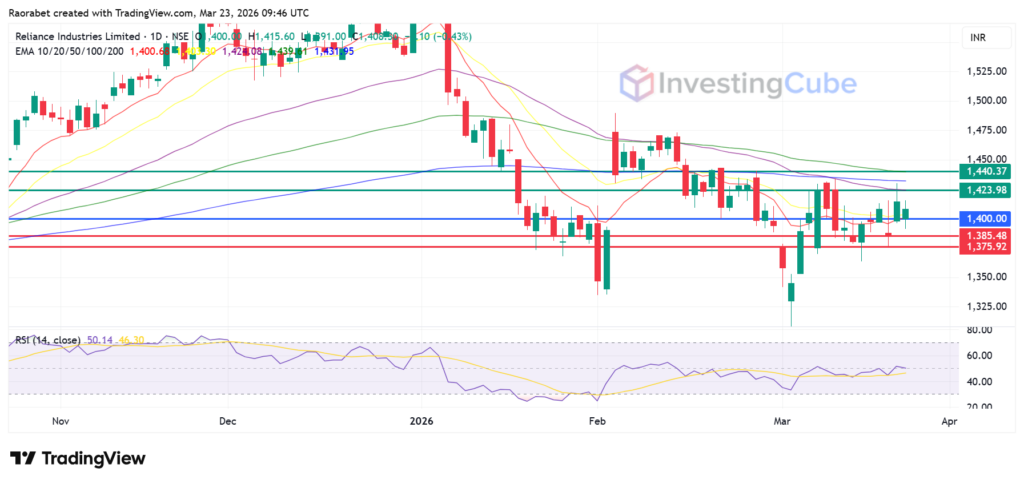
Reliance Stock daily chart showing the key resistance and support levels on March 23, 2026. Created on TradingView
The war caused a global supply crunch in refined products. This sent refining margins (cracks) for diesel and jet fuel to record highs, significantly benefiting Reliance’s O2C segment and offsetting broader market volatility.
Reports suggest the US is allowing India more flexibility to import Russian crude. This ensures Reliance has access to cheaper feedstock, keeping their gross refining margins (GRMs) competitive despite rising global oil prices.