



- Reliance Industries stock has declined sharply, trading below key moving averages, including forming a "death cross"
- The decline is accelerated by a spike in crude oil prices above $100 amid a resumption of windfall tax by the Indian government
- High capex threatens to squeeze margins despite long-term growth projections
Reliance Industries Limited (RIL) began 2026 strongly, reaching a 52-week high of ₹1,611.20 on January 5. Since then, the stock has experienced a downward trend, declining by about 19% from its peak. It recently hit a 10-month intraday low of ₹1,300.20 on the National Stock Exchange, with market capitalization falling below ₹18 trillion.
Over the past five trading sessions, the stock has dropped more than 4%, bringing India’s most valuable listed company close to its lowest level in a year. What factors are contributing to this?
How Did Reliance Stock Get Here?
The recent sharp decline can largely be attributed to rising global crude oil prices, which surpassed $110 per barrel. Although higher oil prices might seem beneficial for an energy company, in this case they have increased raw material costs, imposing pressure on margins in Reliance’s core Oil-to-Chemicals (O2C) segment.
Additionally, elevated capital expenditures related to new energy projects and 5G network expansion have tightened short-term cash flows, prompting some institutional investors to book profits. These elements have combined to accelerate the stock’s sell-off, even as the broader market showed some stabilization.
Another point of concern is the reinstatement of India’s windfall tax on refined fuel exports after its removal in late 2024. While this has added to market unease, the reaction may have been more pronounced than warranted. The current sell-off largely reflects uncertainties about policy rather than a fundamental earnings downturn.
Outlook for Q2 2026
Looking ahead to the second quarter of 2026, the outlook for Reliance remains measured. Should oil prices stabilize and domestic demand recover, earnings visibility for the company could improve gradually. Analysts from JM Financial and CLSA continue to hold positive long-term views but have moderated expectations for the near term, given margin pressures.

The stock’s recovery will likely hinge on successful execution in its retail and telecom businesses, alongside any easing of geopolitical tensions that could help support energy prices. Until clearer positive triggers appear, further gains may be limited.
Reliance’s next earnings announcement is scheduled for April 24, 2026, which will shed light on its Q4 FY26 performance. The outlook for Q2 FY27, ending September 2026, depends on factors such as potential easing of the windfall tax, whether Jio introduces a tariff increase, and if retail margins show signs of recovery.
Reliance Share Price Forecast
From a technical perspective, Reliance’s share price has its RSI at 32.97, signifying a strong grip by sellers. The pivot is at ₹1,312, near the lower Bollinger Band, while key support levels are identified at ₹1,289 and a deeper level at ₹1,270, falling below these could open the way for a slide toward ₹1,220. Conversely, initial resistance appears at ₹1,329, with a more significant barrier around ₹1,358.
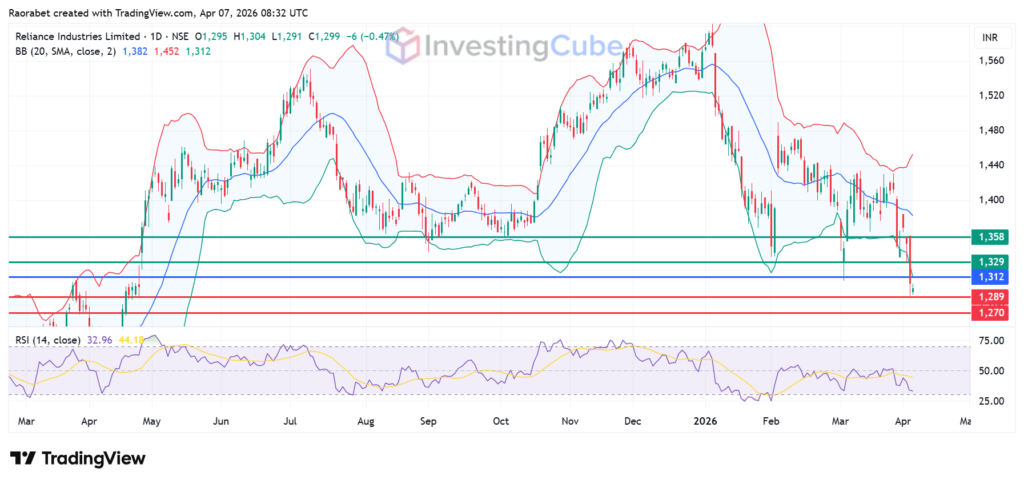
Reliance Industries stock performance on the daily time frame showing key levels of support and resistance on April 7, 2026. Created on TradingView
The sharp decline in early April 2026 was mainly driven by concerns over the impact of rising crude oil prices on margins within the O2C segment.
A recovery is possible through retail and Jio strength if demand improves, but O2C cyclicality limits near-term upside. Consensus may overestimate quick rebound from oil stabilisation.
The outlook for Q2 2026 remains cautious, as margin risks, competitive pressures, and capital expenditure commitments continue to pose challenges.