- IAG share price is down by about 12% year-to-date and its trajectory has diverted significantly from its 2025 performance
- The Middle East constitutes a relatively small but significant earnings pipeline for IAG, but a spike in oil prices due to the war is shrinking margins
- A repeat of 2025 performance is still possible, but much of it will depend on the resolution of Middle East war and oil prices
Only a year after covid-19 pandemic’s worst damage faded, IAG began resembling aviation’s most surprising rebound. Strong earnings and busy long-haul routes across the Atlantic lifted confidence. By mid-2025, investor interest had climbed high enough to push stock prices past where they stood before the crisis hit.
Fast-forward to today, and the sentiment has changed considerably. IAG is down roughly 12% year-to-date and has shed more than 16% of its value over the past month alone. The question on every investor’s mind is if this a rational repricing, or the market overreacting to the latest Middle East crisis?
What Triggered IAG Share Price Sell-Off
The immediate catalyst was the escalation of military conflict involving US, Israeli and Iranian forces at the start of March. The biggest single-day decline in months occurred on March 2, when IAG shares fell as much as 7% in a single session. Flight disruptions and rising fuel prices were the driving forces behind the sell-off.
British Airways cancelled flights to Tel Aviv and Bahrain, and services to Abu Dhabi, Amman, Doha, and Dubai faced multi-day disruptions. IAG’s other carriers, Iberia and Vueling, were also affected. Simultaneously, Brent crude surged toward $80 a barrel, with some analysts warning it could breach $200 if supply routes through the Strait of Hormuz were materially disrupted.
How Much Has the War Actually Hurt Earnings?
To properly assess the earnings impact, you have to start with how strong IAG’s underlying business is. On February 27, the company posted a record full-year operating profit, up 13% to €5 billion, on revenues of €33.2 billion.
Additionally, the company declared its intention to repay shareholders €1.5 billion through buybacks and dividends. In light of this, the direct impact of the war on earnings thus far is probably small but significant. IAG holds a 49% market share on the North Atlantic route, which is far less exposed to Middle East disruption than routes serving that region. The Middle East accounts for a smaller share of IAG’s total revenue mix, meaning route cancellations, while operationally disruptive, are not existential.

The bigger risk to earnings is fuel. Jet fuel constitutes a major cost for IAG, and sustained increases in oil prices would reduce profit margins across all routes, not only those in the Middle East. Analysts warn that if Brent crude reaches $85 per barrel, jet fuel expenses will rise substantially, undermining the strong margins that contributed to last year’s record earnings. Although the company uses hedging strategies, the portion of fuel costs left unhedged has become more expensive.
Can IAG beat its 2025 record?
Looking ahead, surpassing the 2025 record would depend on factors such as an end to the conflict and Brent crude prices falling below $80. On the upside, IAG has benefited unexpectedly from travelers rerouting to avoid Middle Eastern hubs, maintaining strong demand through its London and Madrid gateways to Asia and the US. Should peace be restored soon, this demand combined with IAG’s streamlined cost structure post-pandemic could foster a quicker rebound.
IAG Share Price Forecast
IAG’s RSI is at at 42.32, shows control by sellers, hinting at a near-term price drop. Key support levels sit at 358p and 350p. On the upside, primary resistance lies at 374p which aligns with the Volume Weighted Moving Average (VWMA). Moving past that level will invalidate the downside narrative and potentially result in a stronger momentum to test 383p.
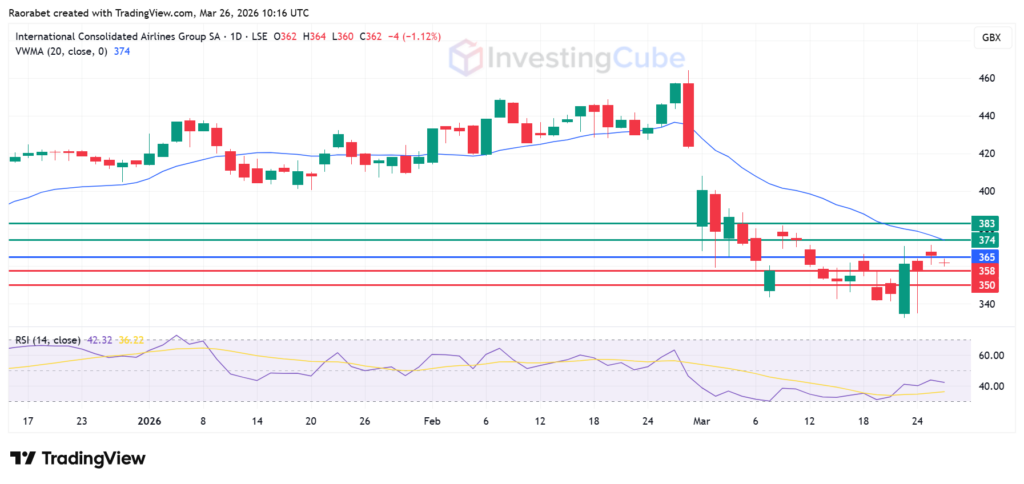
The daily chart of IAG share price showing the key levels of support and resistance on March 26,2026. Created on TradingView
The effect is material but contained. Higher fuel costs from oil reaching $119 per barrel and some Middle East cancellations will pressure near-term margins. However, hedging and diversified routes limit damage.
The exposure is moderate, not critical. IAG’s primary earnings driver is the North Atlantic route, where it holds a 49% market share. Exposure to Middle East markets is moderate, as the company relies more heavily on transatlantic routes for earnings.
A repeat of 2025 performance is unlikely. To do that, there would have to be a combination of conflict resolution, stable fuel costs, and sustained transatlantic demand. Achieving this set of conditions is possible but requires cautious optimism.