



- Meta stock is down by about 17% YTD and the decline could extend following a landmark court ruling on social media addition
- Investors are also concerned about a massive CapEx on AI infrastructure, raised from $115 billion in 2025 to $135 billion in 2026
- However, the company has proven that its AIs have helped improve earnings and a continuation of the same could help the stock rebound
The year 2026 was supposed to be Meta’s victory lap. A strong finish in late 2025 lifted spirits as its earnings hit $8.88 per share, way above analysts’ consensus forecast $8.19. Yet now, as March winds up, excitement feels distant. Instead of news of Meta AI dominance grabbing the headlines, attention turns to lawsuits potentially piling up alongside structural risks inside the business. How did the company end up here and what’s the outlook for the rest of the year?
Why Meta Stock Is Underperforming
Meta’s Q4 2025 results revealed an 18% increase in revenue year-over-year and continued growth in daily active users, as highlighted in the company’s earnings release. Despite these figures, the stock declined notably due to worries over increased capital expenditures on AI infrastructure and a slower-than-expected rebound in advertising within certain sectors.
Analysts from Morgan Stanley and Goldman Sachs pointed out that the market now factors in greater uncertainty regarding Meta’s near-term ability to monetize AI features effectively. Notably, Meta’s projected CapEx for 2026 ranges from $115 billion to $135 billion, marking nearly a 75% rise compared to 2025.
While CEO Mark Zuckerberg emphasizes ambitions around “personal superintelligence,” investors perceive this as a significant strain on free cash flow. This concern intensified after reports of layoffs within Reality Labs and Instagram. Job cuts in such an environment suggest that even with record profits, the financial demands of advancing AI technology require difficult adjustments.
A Landmark Ruling with Immense Consequences
But the biggest blow came from a courtroom in Los Angeles. A jury decided that Meta and YouTube were responsible for making products that caused young users to act in harmful and addictive ways. The verdict assigned 70% of the liability to Meta and determined the companies acted with “malice, oppression or fraud,” leading to $3 million in punitive damages. This ruling sets a precedent that could influence similar legal actions against social media companies.
The decision, stemming from coordinated lawsuits in the US and EU, could force Meta to alter key features of Facebook and Instagram. That could potentially reduce user engagement time and advertising revenue, and could cost the company billions in lost monetisation opportunities. Although the immediate financial impact may be limited, the ruling raises questions about the sustainability of Meta’s core business model.

Can Meta Recover from This?
Meta’s ability to rebound will likely rely less on legal outcomes and more on successfully monetizing its AI initiatives, particularly models like Llama 3 and 4. If Meta can prove that its $100B+ AI spend directly lowers the “cost per acquisition” for its 100 million small business advertisers, the stock will rebound.
With 3.58 billion daily active users across its app family, Meta continues to leverage pricing power and increase ad impressions. Its Q1 2026 guidance points to nearly 30% revenue growth compared to the previous year. At its current level, the stock trades around 25 times earnings, a relatively modest valuation for a company growing at this pace.
Meta Stock Forecast
Meta stock price has broken below all key moving averages, including the 50, 100 and 200-day SMAs. The RSI at 25.65 indicates control by sellers within oversold conditions. Immediate support sits at $543. If this fails, the next major psychological floor is $530. Resistance is heavy at the pivot mark at $560, above which the downside narrative will be invalid. Also, a continuation of control by the buyers at that point could provide the springboard to test the psychological $600 mark.
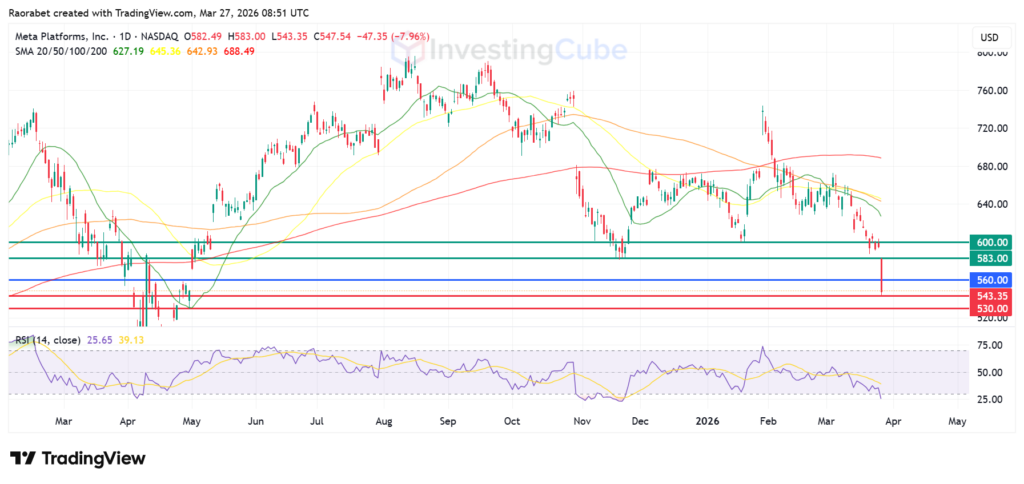
Meta stock price chart on the daily time frame showing the key levels of support and resistance on March 27, 2026. Created on TradingView
The market is scared of Meta’s 2026 CapEx guidance of up to $135 billion, even though the company had a record $8.88 EPS. Investors are worried that the large amount of money spent on AI will cut into free cash flow.
It could force product changes and reduce engagement time, impacting advertising revenue. That could have a negative long-term effect on Meta’s core business model.
A recovery depends on Meta’s ability to prove AI efficiency. If their AI tools significantly increase ROI for small businesses, the stock could rebound strongly.