- IRB Infra share price broke out of ₹22 ceiling for the first time since mid-February, with investors excited with the company's bonus issue
- Beyond the bonus, IRB Infra has a healthy order book backed by substantial TOT management contract pipeline
- Caution is warranted, considering the high valuation IRB Infra is trading at and the execution risk it carries
If you’ve been watching IRB Infrastructure Developers (NSE: IRB) trade quietly between ₹20 and ₹21.50 since mid-February and are now wondering why the stock suddenly shot past ₹22 this morning to hit a year-to-date high of ₹22.70, the answer comes in two parts: a corporate strategy and the psychology around it.
The Bonus Issue Catalyst
The immediate reason for the price movement is the stock turning ex-bonus today for its 1:1 bonus issue. Today marks the ex-bonus date for the company’s 1:1 bonus issue, approved earlier and with the record date set for April 1, 2026. The stock opened at ₹20.56, yet buyers stepped in aggressively.
Although the bonus issue is currently propelling IRB Infra share price uspside, the real momentum follows clear progress on the TOT-18 project’s ground-level rollout. Recently, IRB Infra stepped into a lead role through its special purpose vehicle, IRB Chandibhadra Tollway, now handling management duties under NHAI’s framework.
Can IRB Infra Sustain the Uptrend in 2026?
Looking ahead, the initial boost from the bonus issue is likely to stabilize. Whether ₹22 becomes a sustainable support level rather than a short-lived peak depends on factors that the market has yet to fully consider.
While bonus issues often attract optimism due to perceived higher liquidity, a careful review points to reasons for caution. Bonus shares do not affect overall market capitalization or reduce the company’s considerable leverage. With a Debt-to-EBITDA ratio around 5.1x, the company is still vulnerable to shifts in interest rates.
For the stock to sustain upward momentum in 2026, three conditions should be met. First, traffic across the portfolio needs to grow consistently by more than 15% year-on-year to drive predictable cash flows.

Second, IRB must execute its order book on schedule, particularly the recently secured TOT projects, without significant cost escalations. Third, the company should continue its efforts in reducing debt and recycling assets to manage leverage effectively while supporting capital expenditure.
Given the infrastructure sector’s exposure to execution risks and high leverage, many analysts highlight valuation concerns and macroeconomic pressures that could limit how far this price strength can extend.
IRB Infra Share Price Forecast
The RSI on the price of IRB Infra shares has gone from a neutral 45 to around 63, which is close to being overbought. The stock pivots at ₹21.86 near the 200-day SMA. The first level of resistance is now set at the year-to-date highs of ₹22.70, and the second level is at the psychological round figure at ₹23.00. On the other hand, support has moved to the ₹21.50–₹21.02 zone.
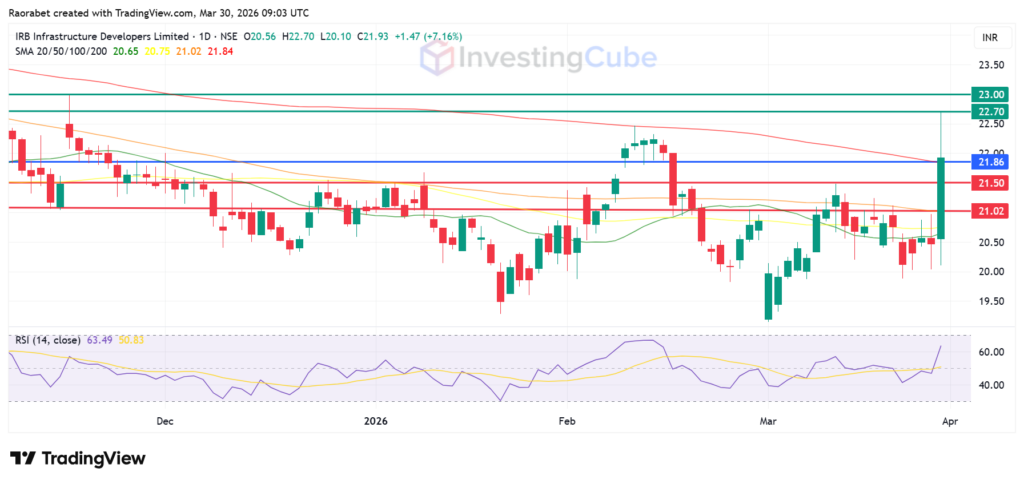
IRB Infrastructure share price performance on the daily chart with key levels of support and resistance on March 30, 2026. Created on TradingView
The stock turned ex-bonus today for a 1:1 issuance. This means the price was mathematically adjusted to account for the doubling of outstanding shares, though high demand pushed it slightly above the expected adjusted level.
The signing of the TOT-18 Project Implementation Agreement confirms IRB Infra’s status as the Project Manager for important highway assets. This means that the company will get a consistent stream of project management fees and long-term revenue visibility.
Debt reduction is necessary for long-term success. The bonus issue increases liquidity, but the company’s high debt level is still a problem. A long-term upward trend needs regular asset monetization through its InvIT platforms and better quarterly net profit margins.