- Barclays share price has dropped sharply since early February, primarily due to news of its exposure to collapsed mortgage lender Market Financial Solutions Ltd
- Higher-for-longer UK interest rates have traditionally favoured banks due to higher NIM, but the current conditions are complex amid Iran war
- Barclays Bank was among the best performing LSE stocks in 2025 and the current trajectory could be reversed if it reports solid earnings in late April
Barclays (LSE: BARC) stood out among FTSE 100 banks in 2025, driven by steady profits and solid returns to shareholders. However, 2026 has seen a significant turn. Its shares have declined by approximately 20 percent year to date and are around 24 percent below the February peak of 506.40p, according to London Stock Exchange figures. This sharp downward trend since early February has raised concerns among investors, even after the bank posted strong full-year results.
What Is Driving the Recent Weakness?
You may wonder why a bank that reported 12 per cent profit growth to £9.1 billion in 2025, upgraded its return-on-tangible-equity target to above 14 per cent by 2028, and pledged more than £15 billion in capital returns has suffered such a reversal.
A sudden tremor in the UK credit scene lit the fuse for this sharp drop. Late last month saw Barclays stock plunge after whispers spread about its links to Market Financial Solutions Ltd’s downfall, a specialist mortgage lender, that collapsed. Reports claimed around £500 million to £600 million of Barclays’ funds were caught up in it. Even though Citi analysts argued the true danger could be lower than thought, the episode stirred fresh unease over weakening loan practices among independent lenders.
Adding to this, the US military action against Iran starting on February 28 led to a sharp sell-off in FTSE 100 financial stocks. Market participants began factoring in the risk of an energy crisis, rising inflation, and a possible recession. UK bank shares, which had benefited in 2025 from stable credit conditions supported by a moderate rate environment, suddenly appeared vulnerable to these new economic pressures.
Third, and most structurally significant, was the removal of the rate-cut catalyst that had underpinned much of the 2025 banking re-rating. Before the conflict, markets had priced in multiple BoE cuts through 2026. The Iran war effectively extinguished those hopes, with markets now pricing in the possibility of rate hikes rather than cuts.
BoE Rate Decision and What It Means for Barclays
On March 19, 2026, the Bank of England kept interest rates steady at 3.75%, but its commentary had a hawkish tone. The BoE cautioned that the Middle East conflict may add inflationary pressures, potentially pushing consumer price inflation toward 3.5% later this year.
While higher interest rates typically improve bank margins, benefiting institutions like Barclays, the situation is more complex. Elevated energy costs could sustain inflation, limiting the BoE’s ability to reduce rates and supporting higher net interest margins.

Yet, the broader economic effects of prolonged inflation and slower growth, such as rising credit losses, reduced mortgage lending, and weaker capital markets activity, could counterbalance those margin gains throughout 2026. This creates a more intricate outlook than some optimistic views suggest.
Is a Rebound Coming or Is There More Downside?
Attention now turns to Barclays’ first-quarter earnings report due on April 28, 2026. Should credit quality remain stable and revenues from investment banking improve due to market volatility, the results might spark a recovery. Conversely, if charges related to Market Financial Solutions increase or if guidance is lowered, shares may face additional pressure.
Barclays Share Price Forecast
Barclays share price RSI is at 3478, indicating a slide into oversold territory. Immediate support is located at 371p. A breach here opens the door to YTD lows of 361p. Resistance is stiff at 397p, with a major hurdle at the psychological 400p mark. A move past that could open the path to test 410p, currently aligning with the 10-day SMA level.
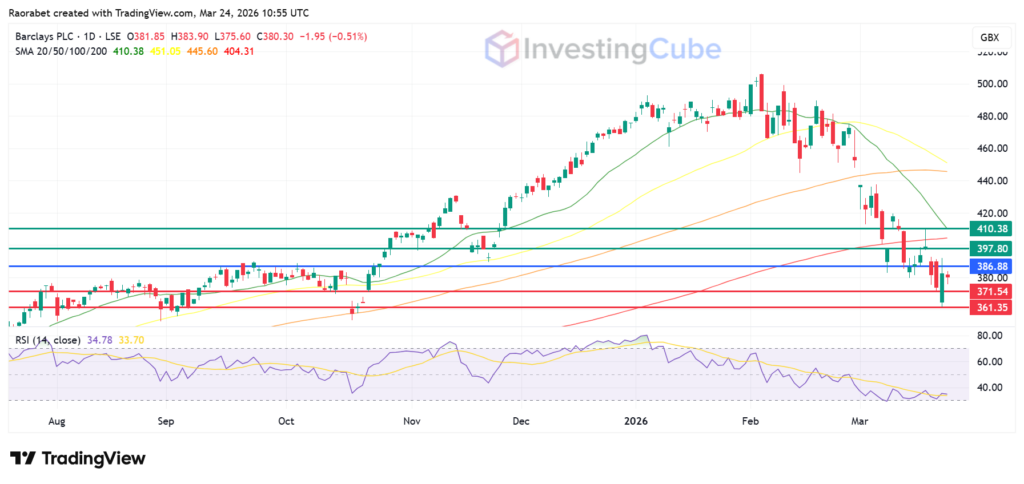
Barclays Plc stock daily chart with key levels of resistance and support for March 24, 2026. Created on TradingView
The decline was triggered by fears of exposure to the collapse of a specialist mortgage lender and broader concerns about private credit. This was exacerbated by a “hold” on interest rates by the BoE.
The BoE held rates at 3.75% but warned of new inflationary pressures from the Middle East. This hawkish tone dampened hopes for rate cuts, leading to worries about economic stagnation and bad loan provisions.
A de-escalation in Middle East tensions restoring rate-cut expectations, clean Q1 results on April 28 and a sustained break above 410p on strong volume would collectively constitute a credible reversal setup.