- Rising volatility in India's equities has resulted in increased trading volumes at the BSE, boosting earnings when the broader market struggles
- Market regulator SEBI's approval of BSE's launch of derivative contracts for the SENSEX Next 30 index has created a significant earnings avenue
- BSE's expansion in the derivatives segment provides stability, but the NSE still commands most of the market share
BSE Ltd, which operates the Bombay Stock Exchange, has shown resilience despite broader market declines in early 2026. While the SENSEX and Nifty 50 have fallen by around 7% and 6% respectively over the past month, BSE share price has risen by over 8%, currently trading near ₹3,000. Since hitting lows on March 4, the stock has gained almost 16%. To fully grasp this performance, it’s important to look beyond conventional market narratives.
The Earnings Engine
A massive leap in earnings marked BSE Ltd’s Q3 FY26 results. Profit after tax hit ₹601.81 crore, translating to a growth of 174% year-on-year. Sales climbed by 62%, reaching ₹1,244 crore during the three months ending December 2025. Behind those figures, operating EBITDA jumped close to threefold at ₹732 crore. Margin strength grew sharply, moving from 31% all the way to 59%. Eleven quarters in a row now show rising income totals.
Why BSE Thrives in Turbulence
The reasons behind BSE’s success amid market challenges may seem counterintuitive. Factors such as geopolitical tensions, including the Iran-Israel-US conflict, and rising crude oil prices, have negatively impacted most stocks and increased market uncertainty. However, these same conditions tend to boost BSE’s business.
For instance, the India VIX jumped nearly 80% over two weeks in early March, climbing from 13 to 25 as geopolitical tensions rose. This spike in volatility tends to increase derivatives trading volumes, directly benefiting exchanges like BSE through higher transaction fee income. Unlike many companies hurt by market turmoil, BSE benefits structurally from such periods of instability.
This effect is especially evident in derivatives trading. On March 4, SEBI approved BSE’s launch of derivative contracts for the SENSEX Next 30 index. This expands their Futures & Options product offering, adding a new instrument that can help BSE compete more effectively with NSE, which has traditionally maintained a dominant position.
Is the Momentum Sustainable?
Regarding sustainability, many market participants view BSE mainly as a cyclical beneficiary tied to retail investor activity. Yet there appears to be a longer-term shift underway. Previously trailing NSE, BSE is now focusing on specialized market segments and developing tailored products.

I would contend that the opposite is true, despite some analysts’ warnings that a market stabilization could end the momentum. BSE’s expanding derivative offerings, including the recent Focused Midcap index contracts, position it as a venue catering to more sophisticated trading and hedging needs. If the company maintains competitive transaction fees, this momentum could reflect a fundamental revaluation rather than a short-term spike.
BSE Near-Term Risks
Continued gains depend in part on broader market recovery and regulatory stability. A further decline in equity volumes could slow revenue growth and pressure the stock’s current valuation. Other risks include sustained market weakness reducing trading activity, intensified competition from NSE’s innovations, and potential regulatory changes affecting fee structures.
BSE Share Price Forecast
BSE share price’s MACD reading of 29 on the daily chart confirms control by buyers. Primary resistance will likely be at ₹3,025, while a sustained move above that mark could pave the way for a rally reaching around ₹3,100.Immediate support levels are identified around ₹2,893, with stronger support near the 20-day exponential moving average at ₹2,834.
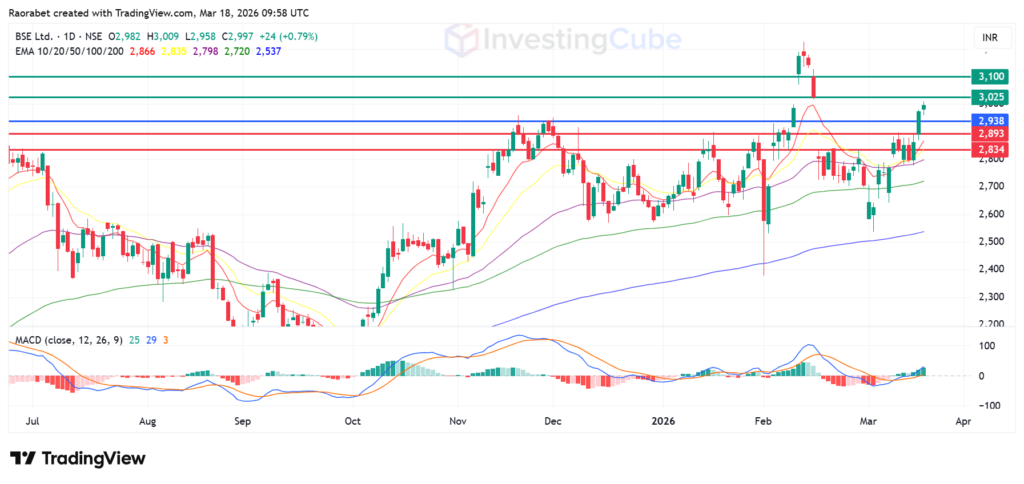
BSE stock’s performance on the daily time frame, showing key resistance and support levels on March 18,2026. Created on TradingView
BSE makes more money from transaction fees when trading volumes are high in volatile markets, especially in derivatives. Combine that with strong Q3 earnings and fresh SEBI approval for new derivative products, and the outperformance is well-grounded.
SEBI recently approved the launch of derivative contracts for the SENSEX Next 30 and Focused Midcap indices. This expands BSE’s F&O portfolio to four indices, significantly boosting its ability to compete for market share against the NSE.
NSE is still the clear leader in India’s F&O market. The new indices add to BSE’s product line, bringing the total to four. However, getting real institutional flow from NSE will take time and effort, not just weeks.