


- Despite current technical consolidation and a slowdown in legacy units, Broadcom’s massive 106% surge in AI-driven revenue positions it as a dominant infrastructure leader alongside Nvidia.
- While the chart indicates a short-term bearish phase below the $340 resistance, the company’s strategic shift toward custom AI accelerators and high-end networking remains the primary fundamental engine for long-term growth.
Broadcom is one of the “heavyweights” of the tech world. They design and supply the semiconductors (chips) that power almost everything. You can imagine they provide every single chip that powers your smartphone’s Wi-Fi to the massive data centers that run the internet. This is only on the hardware side; on the software front, they own the major software companies like VMware. This technology helps businesses run their cloud infrastructure.
At the time being, Broadcom (AVGO) is a key player in the AI revolution. AVGO builds custom chips for companies like Google and Meta to help run their artificial intelligence programs. AVGO grabs tech investors’ attention as of early April 2026. The company announced long-term AI chip deals with Google and Anthropic. Such an announcement led the stock to move upward significantly, trading around $326.
Broadcom AVGO is sensitive to the main ongoing macro forces: geopolitical tensions between the U.S. and Iran. On the other side, the interest rates, particularly those of the Federal Reserve, reflect the strength of the US dollar. Tech investors weigh high growth in AI against the risks of a strong U.S. dollar.
Strategic Partnership Between Broadcom, Google, and Anthropic Drives AVGO’s rally:
Recently, Broadcom disclosed its long-term partnership with Google in which it will design and supply custom tensor processing units (TPUs). This partnership aims to cover Google’s next-generation infrastructure. Additionally, from now until 2031, Broadcom is set to supply networking components and data center solutions to Google.
Broadcom also expanded its partnership with Anthropic, strengthening its role in the next-generation computing infrastructure. Starting in 2027, Broadcom will give Anthropic access to approximately 3.5 gigawatts of TPU-based computational capacity. This is part of a bigger plan to expand their high-performance computing capacity and handle more advanced tasks. Moreover, ongoing discussions remain for additional partners to support large-scale deployment.
With the Broadcom–Google–Anthropic partnership explained, here’s why it matters for AVGO stock and tech traders.
What the Partnership Means for AVGO Stock and Tech Investors:
- This long-term partnership highlights the growing demand for Broadcom’s custom chips, reflecting the company’s stability and potential for long-term growth. It boosts investor confidence in AVGO stock, enhancing its appeal. As a result, AVGO’s performance is expected to remain strong, favoring tech investors.
- The deal positions AVGO for continued growth in the tech sector, suggesting the stock could perform well and benefit tech-focused portfolios.
- Analysts’ expectations confirm a strong growth in Broadcom (AVGO) stock. As Rosenblatt Securities lifts its price target for AVGO to $500. This signals confidence in the company’s long-term growth prospects even amid short-term market fluctuations.

Broadcom doesn’t just strengthen its position through the long-term partnership with Google and Anthropic; it is also building a broader ecosystem of collaborations across the technology sector, including Microsoft, OpenAI, and NVIDIA. These partnerships are expected to expand Broadcom’s market share in high-performance computing.
After examining what this partnership reveals and its impact on AVGO stock, let’s take a technical look at the chart to see how the stock has reacted to these positive developments and growing momentum.
Broadcom AVGO Stock’s Technical Outlook:
The price action shows a significant shift in market sentiment over the past eight months. After a strong bullish trend that peaked in late December 2025, reaching approximately $414, the stock entered a corrective phase. A major bearish phase triggered in early February 2026 as the price broke below its primary trend line.
Currently, the stock is struggling to find a bottom, trading around $324.11. The price has remained consistently under the red resistance band, acting as a dynamic ceiling throughout March and April. The RSI sits around 59, suggesting that while the stock is moving out of the oversold zone, it hasn’t yet regained strong bullish momentum to reclaim its previous highs.
The immediate resistance level sits at $350. A sustained break above this level could support the price to reclaim its previous highs, reaching $375 and then $400. Until this technical move takes place, the market seems to be waiting for the next quarterly confirmation that the AI growth is enough to offset the slower legacy business. While AI is booming, Broadcom’s traditional infrastructure software and non-AI semiconductor units have seen sluggish growth, with some segments growing by only 1%. This performance caused a contraction in gross margins. Therefore, technical traders are reacting to that.
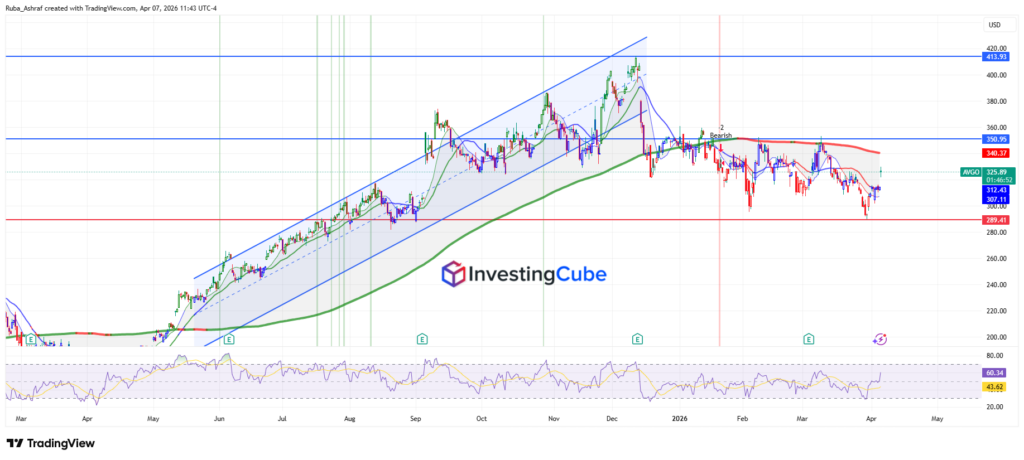
While AI growth is explosive, it currently accounts for about half of Broadcom’s business. The “Bearish” signals on the chart reflect a temporary drag from the company’s legacy units, which have seen sluggish 1% growth.
Investors are currently weighing this transition period, waiting for AI dominance to fully offset the slower performance of older divisions.
They are “co-opetitors.” While Nvidia dominates the GPU market for processing AI, Broadcom leads in custom AI accelerators (XPUs) and the high-end networking switches that connect thousands of GPUs together.
In short, Nvidia builds the “brains” of the AI data center, while Broadcom builds the “nervous system” that allows those brains to communicate at scale.