- BP stock has risen steadily in the last two weeks, mirroring the global oil price rally
- The company transits about 12% of its product s through the Strait of Hormuz, meaning it is relatively well cushioned elsewhere
- Rising oil prices favour oil producers like BP but slowing manufacturing could limit the extent to which oil price could rise
BP stock has experienced a steady upward trend for over two weeks, driven largely by the recent surge in global oil prices amid rising tensions in the Middle East. As Brent crude prices climb, the possibility of a significant blockade at the Strait of Hormuz has elevated concerns about supply interruptions and their potential impact on BP’s earnings.
Although the two-week rally might appear straightforward, the situation involves more nuanced factors.
The Hormuz Supply Shock vs. Strategy
The primary engine behind this rally is the escalating tension in the Strait of Hormuz. Because tanker movements are barely happening now, traders expect supply to fall short by 7 to 12 million barrels daily. Even though the International Energy Agency (IEA) made 400 million barrels available, it doesn’t change much. Given how much usually moves through the strait, which is around 20 million barrels each day, that reserve lasts less than three weeks.
For BP, the impact is twofold. On the one hand, any disruption to Middle Eastern flows has a direct impact on global supply and drives Brent crude closer to $120. However, these prices have a natural effect on BP’s earnings. The market consensus often misses a vital detail, which is BP’s diversification.
Unlike some regional competitors more vulnerable to a Strait blockade, BP has moved forward with its Kaskida project in the Gulf of Mexico and commenced gas production in Angola, helping to reduce reliance on the Hormuz corridor.
Goldman Sachs estimates that roughly 12% of BP’s output comes from the Gulf region, suggesting that these alternative sources could help sustain or even improve pricing and margins despite Middle Eastern uncertainties.

Will High Prices Survive a Manufacturing Slump?
A common concern is that high oil prices will eventually crumble under the weight of a global manufacturing slowdown. Oil prices are likely to remain elevated in the near term due to the blockade’s chokehold on supply, but manufacturing slowdowns could temper the upside over time.
Brent has already moved toward the $100–$110 range in recent sessions. Still, pricier energy is slowing things down at refineries and factories. Forecasts from JPMorgan along with the EIA point to averages between $60 and $90 by 2026, once early surges settle. That outlook factors in rising stockpiles and non-OPEC expansion. The EIA’s short-term forecast says that Brent will stay above $95 for the next two months.
BP Stock Price Forecast
BP stock price pivots at 560p and RSI at 73.39 signals strength, but with the risk of overbought conditions. The nearest resistance level is the upper Bollinger Band at 579p, and if the stock breaks above this, it could move toward 590p. On the downside, solid support holds at 535p, followed by another significant floor at the middle Bollinger Band at 510p.
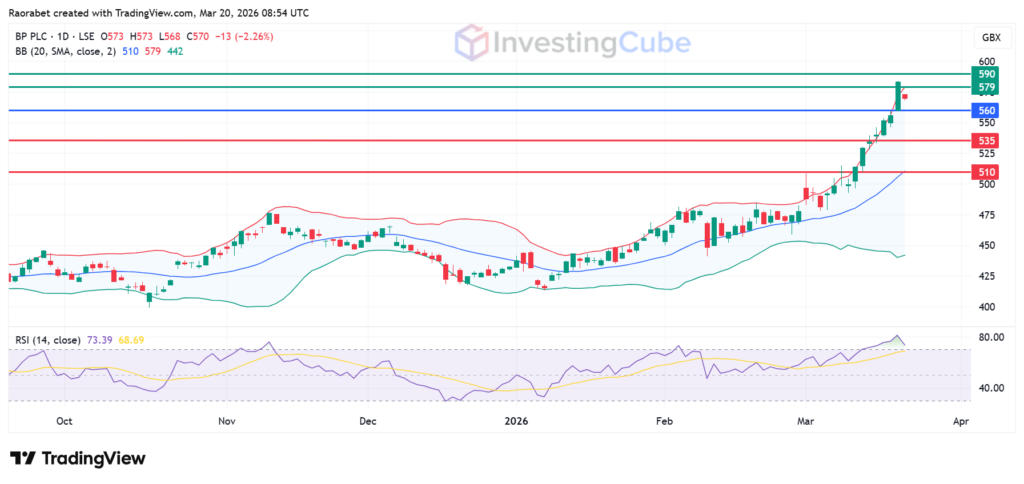
BP Stock on the daily time frame showing the key levels of support and resistance on March 20, 2026. Created on TradingView
Near-term yes from supply tightness, but manufacturing hits and inventories could pull them lower; consensus may overestimate persistence, favouring BP’s integrated resilience
While reduced demand from manufacturing poses a risk, current supply shortages are expected to keep Brent prices above $95 for at least the coming two months, indicating that scarcity is currently a stronger influence than slowing industrial activity.
The most significant risk lies in a swift resolution of the Hormuz conflict, which would likely remove the premium associated with geopolitical risk and could weigh on oil prices and, by extension, BP’s stock performance.