


- Bajaj Finance stock has been underperforming after it proactively lowered growth targets to 22-23%, prioritizing risk management in MSME and rural lending sectors
- Periodic spikes in recent days, including today’s 4% surge shows promise, but a true recovery requires clearing the critical ₹850 resistance level
- The "FINAI" transformation leverages AI for hyper-personalization, potentially lowering long-term operational costs despite current credit headwinds.
After a challenging March during which Bajaj Finance stock (NSE: BAJFINANCE) lost close to 20% of its value, its share price showed a notable rebound on April 1, 2026, rising over 2% intraday to around ₹835. The stock had been affected by a 15% year-to-date decline, influenced by a combination of geopolitical concerns and a downward revision in asset growth forecasts.
Why Bajaj Finance Struggled in the First Quarter of 2026
The rot started in early February with the results for Q3FY26. Bajaj Finance’s net profit was ₹4,066 crore, which was a 5.6% drop from the previous year and a big miss compared to analysts’ forecast of around ₹5,173 crore. Revenue from operations went up 17.5% from the previous year to ₹21,214 crore, and net interest income went up a healthy 21% to ₹11,317 crore. So, for the most part, the underlying lending engine was working well.
However, the more significant impact came from a substantial, intentional provisioning charge. StockEdge’s analysis highlighted an accelerated Expected Credit Loss (ECL) provision of ₹1,406 crore and a one-time ₹265 crore exceptional expense related to new labor regulations.
When excluding these items, the underlying net profit actually rose by 23% year-on-year. Additionally, the company’s assets under management (AUM) expanded 22% to roughly ₹4.85 lakh crore, with loan originations growing 15%. These figures indicate the fundamental operations remain sound.
What Is Fueling the Recent Intraday Rebound?
The latest jump seems sparked less by news and more by traders stepping in during recent lows. Volume-heavy rebounds have followed extended downswings multiple times in recent days, sometimes exploding midday when activity heats up unexpectedly.
Investor sentiment shifted notably after management lowered the asset growth forecast for fiscal 2026 to 22-23%, down from earlier projections near 25%. While market attention remains on the slower growth, the company’s ongoing “FINAI” transformation (its long-term initiative to employ AI for highly personalized lending), could provide meaningful efficiency improvements over time.

Why the Surge Today?
The more than 2% rise today coincided with a broader market rally triggered by the Reserve Bank of India’s decision to delay stricter capital market exposure rules until July. This postponement offers non-banking financial companies (NBFCs) additional flexibility in managing liquidity. Furthermore, with the stock’s Price-to-Book ratio contracting toward 5x, a level historically seen as value territory for this premium lender, institutional buyers appear to be stepping in.
Bajaj Finance Share Price Forecast Today
Bajaj Finance is trading near ₹818, well below its 52-week high of ₹1,102.50. Immediate support is likely at ₹788, corresponding with the 52-week low and a demand zone established over several months. Secondary support can be found between ₹770 . On the upside, resistance lies near ₹850, and the second key hurdle will likely be at ₹880, near the 20-day SMA.
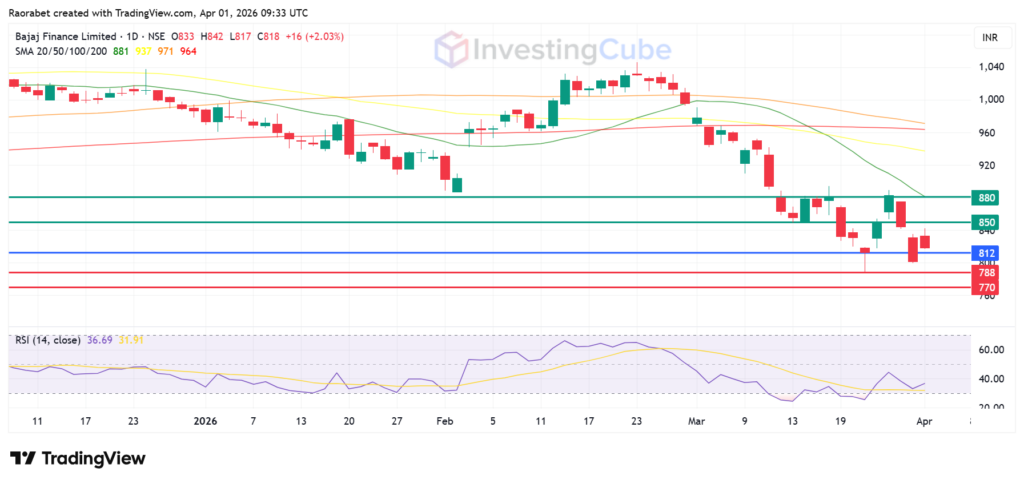
Bajaj Finance share price on the daily chart showing key levels of support and resistance on April 1, 2026. Created on TradingView
It is a relief rally supported by RBI’s regulatory postponement. However, technicals suggest caution and the stock remains in a bearish channel until it clears its 20-day moving average near ₹880.
Given the ongoing downtrend and high valuation, a long-term recovery is unlikely in the near future. The market consensus may put too much weight on intraday bounces because of geopolitical and credit risks.
Most analysts focus on the growth slowdown. But they might be overlooking how the FINAI AI integration will help Bajaj Finance be more productive in the long run.