


- Ola Electric share price has rallied in the last two sessions, gaining more than 20% driven by strong sales in March and substantial operational improvements
- Despite the uptick, the stock trades below key moving average levels, meaning long-term investors are still potentially in loss
- The company has embarked on an aggressive pricing strategy for its Roadster, but that could squeeze margins
Ola Electric stock (NSE: OLAELEC) hit highs above ₹70 last year, but it spent months going down, and it recently hit its 52-week low of ₹22.25. But the story has changed in the last 48 hours. Ola Electric shares have gone up more than 20% in two sessions, with a 9% rise in one day on April 2 alone. On the NSE, more than 180 million equity shares changed hands.
Why Ola Electric Share Price Popped Up
The trigger was the company’s March business update. In March, there were 10,117 total registrations, up from 3,973 in February. This is an increase of more than 150% from the previous month. In the last week of the month, daily orders went over 1,000 units. That is a very clear sharp operational rebound, and the market reacted in kind.
Two operational improvements have contributed to the recent performance. More than 80% of vehicles are now serviced on the same day, a result of improved parts availability, quicker diagnostics, and enhanced operational oversight. These adjustments have helped rebuild customer confidence and are supporting increased demand. Additionally, Ola reached a significant milestone by becoming the first Indian electric vehicle brand to surpass one million cumulative registrations, based on VAHAN data.
Aggressive Pricing Strategy
Ola Electric recently implemented an aggressive pricing approach, reducing the price of its flagship Roadster X+ 9.1 kWh by ₹60,000 to ₹1,29,999. This price change goes beyond a typical promotional discount and signals a clear strategy aimed at competing with internal combustion engine (ICE) vehicles.
The company attributes this move to cost benefits derived from its Gigafactory operations and the in-house production of the 4680 Bharat Cell, enabling it to pass some savings onto customers. Ola is counting on higher sales volume to offset the lower margins that have affected recent financial results.
However, this pricing strategy does introduce execution risks. It tightens margins on a key product that the company needs to turn profitable. Given that the electric motorcycle market in India remains relatively small, it is uncertain whether the Roadster will generate the volume needed to significantly shift the company’s overall performance.

Is This the Beginning of a Reversal?
One thing is clear – nobody can say for sure if things will fully turn around soon. Relief came with the recent rise, following steep losses early in 2026. However, long-term success hinges on steady performance alongside rising buyer interest. Momentum appears stronger based on March data. Even so, rivals keep pushing hard in the electric two-wheeler market, making reliable service essential to hold customers.
There are notable risks for the April–June quarter. Ola Electric reported a net loss of ₹487 crore in Q3 FY26 alongside a 55% year-over-year revenue decline, with operating cash flow staying negative. A single month of improved registrations does not address these underlying financial challenges.
Ola Electric Share Price Forecast
Ola Electric is attempting a V-shaped recovery from extreme oversold conditions. The RSI at 60 indicates control by buyers without the risk of overbought conditions. The stock faces immediate friction at ₹28.65, followed by the psychological round figure ₹30.00. To confirm a structural trend reversal, the price would have to break out above ₹35. The pivot is at ₹25.00 while the primary support is at ₹22.25. At ₹23.17, a second support zone is set up.
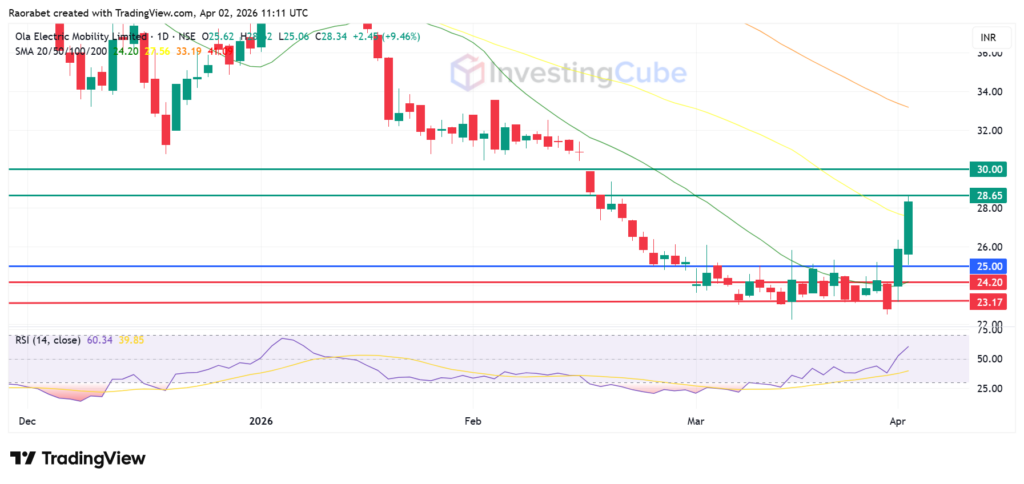
Ola Electric share price daily chart showing key levels of support and resistance on April 2, 2026. Created on TradingView
The rally is driven by a massive ₹60,000 price cut on the Roadster X+ and news that March registrations grew 150% month-on-month.
They mark the first major positive update after months of weakness and signal improving demand. This challenges earlier pessimism, as service enhancements appear to be paying off.
The primary risk is margin erosion. By slashing prices so aggressively, Ola risks deepening its net losses if the volume of sales doesn’t grow fast enough to cover fixed operational costs.