



- The S&P 500 index is at its lowest since September 2025 and there's emerging talk of a recession if the Middle East war continues for long
- US energy independence has cushioned it against adverse impacts, unlike Europe which relies on imports
- The Federal Reserve's interest rate play has an immense influence on how the US economy will come out of this, and elevated rates for longer could lead to an economic slowdown
The S&P 500 Index closed at 6,368.85 on Friday, its lowest position since September 2025. This drop, which started in the middle of February, has erased almost all of the gains made since the start of the year. The main reasons appear clear: oil prices are rising to $115, and rising uncertainty in the world. But the real story is what this means for the remainder of the year.
A Sellers’ Market
The five-week slide marks the S&P 500’s worst stretch since 2022, back when steep hikes from the Federal Reserve sparked a brutal downturn in stocks in the post-pandemic era.
The current downturn has been primarily influenced by escalating tensions in the Middle East. Military actions involving the U.S., Israel, and Iran have driven oil prices upwards, reintroducing concerns about supply disruptions. Market analysts, including those at Forbes, note that these events have unsettled investors and pushed energy costs higher at a time when inflation remains persistent.
Is A Recession Incoming?
Caution is growing among market watchers. According to Moody’s AI-based recession model, the probability of a downturn is now close to 49%, the highest level seen in recent years. This has fueled speculation about a possible recession in 2026, with many experts linking the S&P 500’s weaknesses to these risks. They point to ongoing oil price shocks and cautious policy moves as potential factors that could tip the economy into contraction.
The U.S. differs from European and Asian markets as a net energy producer. Although the supply shock is significant compared to past decades, the increase in prices has been relatively muted, partly because markets anticipate a swift resolution to the conflict.
Additionally, the diversification of oil sources and the strategic reserves held worldwide have lessened the impact for Western economies compared to the 1970s. Energy sector stocks have risen by about 25%, while consumer staples such as food, beverages, and tobacco have seen minimal declines, under 1%, indicating selective market responses rather than widespread sell-offs.

Moreover, the substantial fiscal stimulus introduced in 2025, which Morgan Stanley estimates will provide over $170 billion in consumer support through 2026, may offer a buffer that markets have not fully factored in. The greater threat to the economy could come from policy missteps, particularly if the Federal Reserve raises rates amidst a slowing economy beyond manageable levels.
S&P 500 Index Forecast
The S&P 500 is in a precarious position, having recently broken below its 200-day moving average for the first time since mid-2025. The first key resistance is likely at 6,562, with the second one at 6,634. Immediate support lies at 6,300, below which the next support could be at 6,20, with an extended control by the seller potentially pushing it down to the psychological 6,000 area.
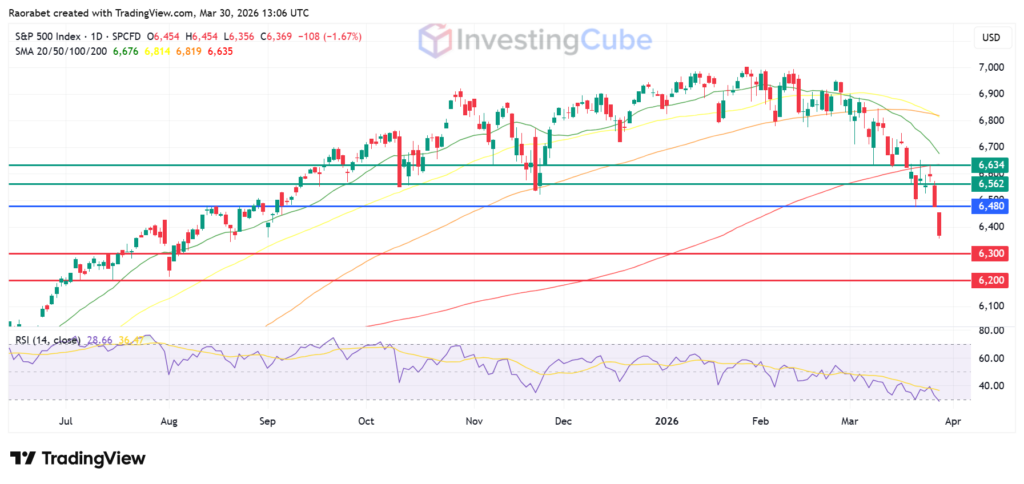
S&P 500 chart showing the key levels of support and resistance on March 30, 2026. Created on TradingView
A combination of crude oil prices hitting $100, rising interest rates, and geopolitical uncertainty in the Middle East led to a massive re-evaluation of equity valuations, pushing the index to its lowest level since September 2025.
Further downside toward 6,200 remains possible if oil shocks persist. However, the speed of the drop and oversold momentum indicators increase the chance of a near-term stabilization or relief rally.
While many analysts warn of sustained weakness, the combination of resilient earnings and extreme oversold readings offers a contrarian edge. The decline may reflect exaggerated fears rather than the start of a deeper downturn