



- The Nifty 50 Index gapped up on April 8 on news of US-Iran ceasefire, which translated to lower oil prices and reduced risk aversion
- The talks broke broke down on the first attempt over the weekend, sending oil price back above $100
- India's large oil import bill and geopolitical risks from a prolonged standoff in the Middle East has sent the Nifty 50 below the psychological 24,000 points
On April 8, 2026, the Nifty 50 Index experienced a notable surge, gapping up and breaching the significant 24,000 level, a mark not touched in a month. This move followed the announcement of a US-Iran ceasefire and a considerable decline in oil prices. Despite this strong start, the index has found it challenging to hold onto those gains, subsequently retracting to approximately 23,830. Why has such a strong opening move has reversed so quickly?
Why is the Nifty Reversing Gains?
The US-Iran ceasefire announcement along with cheaper oil sparked wide gains that pushed Nifty close to 23,997, yet buyers didn’t return afterward. Selling picked up because large bets against rallies built up around the 24,000 level while foreign investors kept pulling money out. Fast spikes often happen when sidelined traders rush to exit shorts, though such moves tend to fade without lasting support from real appetite.
Over the weekend, ceasefire negotiations between the U.S. and Iran in Islamabad unfortunately collapsed. For a country like India, which is highly sensitive to energy costs, any threat to the Strait of Hormuz, a vital oil artery, sends immediate shivers through the Nifty.
The RBI’s Struggle
As of this update, the Nifty 50 was at 23,808, marking a decline of 242 points, or 1.01%. This occurred as the index experienced profit booking following a five-session upward trend. Key decliners included INDIGO, down 3.61%, JIOFIN at 3.19%, LT with a 2.89% drop, SHRIRAMFIN losing 2.70%, and ETERNAL falling 2.47%. Additionally, several major banking institutions contributed to the downward pressure, such as HDFCBANK, down 2.22%, KOTAKBANK by 2.18%, SBIN with a 1.98% decrease, and ICICIBANK, which saw a 1.96% dip.
Further compounding the uncertainties arising from the Strait of Hormuz situation is the Reserve Bank of India’s (RBI) official position. On April 8, the Monetary Policy Committee (MPC) maintained the repo rate at 5.25% along with a neutral policy stance. Although the market initially responded positively to this decision, a clearer understanding of the implications is now emerging. The RBI has indicated that inflation for FY27 is anticipated to increase to 4.6% from its earlier, lower projections.
Most analysts argue that the RBI is being accommodative enough. However, a more contrarian view suggests the RBI is actually in a corner. Rising global bond yields, along with shaky oil price make the idea of steady policy look less like balance and more like caution born from limits. Holding back on rate cuts now could mean protecting the currency, not confidence. The recent stall in Nifty may signal investors waking up to the reality that cheap liquidity isn’t knocking yet.

Is a Deeper Decline Coming?
The prevailing market sentiment suggests a cautious optimism, interpreting the current situation as a healthy consolidation before the next upward movement. However, this perspective warrants further scrutiny. The initial two-week ceasefire represented a diplomatic starting point rather than a definitive resolution.
The unproductive nature of the Islamabad negotiations between the U.S. and Iran demonstrated a continuing significant divergence between the two sides. The collapse of these discussions has already pushed crude oil prices back above $100, potentially leading to additional FII outflows from Indian equity markets.
Nifty 50 Index Forecast
The 24,000 mark, once a psychological benchmark, now presents itself as a substantial overhead resistance level for the Nifty 50 Index. The index pivots at 23,910 and the Relative Strength Index (RSI) on the daily chart has moved from 65 down to 52, indicating a diminished upward momentum. Key support levels are identified at 23,501 corresponding to the 10-day EMA, with the critical 23,307 mark following thereafter.
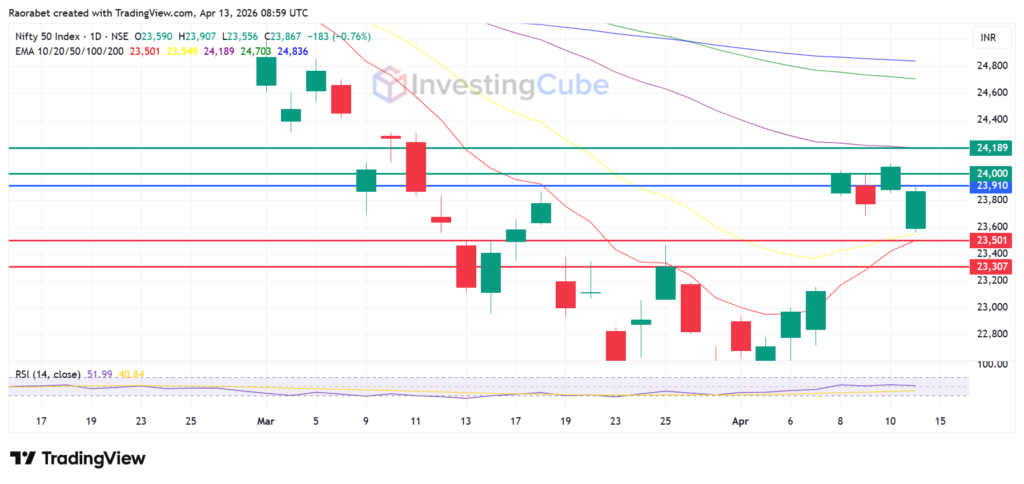
Nifty 50 Index on the daily chart on April 13 showing the key levels of support and resistance. Created on TradingView
The reversal was triggered by the failure of U.S.–Iran ceasefire talks over the weekend. This sparked fears of a Strait of Hormuz blockade, driving crude oil prices back above $100 on Monday.
Yes, the 24,000 mark has now established itself as a significant psychological ceiling. Technical analysis indicates that consistent inability to break past this level points to considerable selling pressure. For investor confidence in a durable rally to be re-established, the index needs to achieve a decisive close above this threshold.
The Iran-US peace negotiations. A credible agreement would ease crude prices structurally, strengthen the rupee, reduce inflation risks, and potentially flip FIIs from net sellers to buyers.