



- FTSE 100's relief rally is fading as ceasefire optimism loses momentum.
- Energy, mining, and defensive stocks are helping cushion the index.
- Middle East tensions and oil prices remain the main drivers of sentiment.
- US CPI could be the next key trigger for FTSE 100 direction.
Relief Rally Starts to Lose Momentum
The FTSE 100 starts today’s session in a somewhat more precarious position than the recent rebound may imply. The index rallied to a more than one-month high earlier this week after talks of a U.S.-Iranian ceasefire boosted global risk appetite and set at ease fears over a deeper Middle East energy shock. (Reuters, 8 April 2026, “FTSE 100 Rallies to Over One Month High After US-Iran Ceasefire Agreement”). But that optimism quickly dissipated as the day went on, with investors starting to doubt just how durable the ceasefire is.
By the following session, UK stocks had started rolling over as speculation about how long the truce would hold reared its head again and oil prices crept up once more. (Reuters, 9 April 2026: “UK Stocks Lose Steam on Middle East Ceasefire Doubts”). This indicates to us that the FTSE 100 is no longer moving solely on pure relief, but rather a more measured re-evaluation of geopolitical and inflation risk.
Why FTSE 100 Has Been More Resilient
One reason that the FTSE 100 has so far held up comparatively well is its sector composition. These are not growth-heavy indices, and the FTSE 100 contains a large share of:
- Energy giants
- Miners
- Banks
- Defensive healthcare names
That structure can help insulate the benchmark when commodity prices are on the rise.
Higher crude prices can provide near-term support to heavyweight stocks like Shell and BP in the current environment. This is relevant because it implies that the FTSE 100 will not react to geopolitical stress like those indices dominated by technology or domestic cyclicals.
But this support does not come without limits. If the case for higher oil is increasingly one of inflation problems rather than a profit boost for energy companies, then there may be pressure on the wider index as rate expectations tighten.
Geopolitics Remains the Main Driver
For the moment, the Middle East is the overwhelming factor in market direction. The ceasefire provided investors with the initial sense that the risk of a drawn-out period of supply disruption could subside. However, when the market grew skeptical that the agreement would hold, the relief trade began to fade.
Reuters noted that UK equities pulled back as renewed doubts about the ceasefire pushed oil prices higher again. (Reuters, April 9, 2026: “UK Stocks Lose Steam on Middle East Ceasefire Doubts”). That is important because an oil rally is not merely a stock story, but feeds directly into inflation expectations, bond yields and broader equity valuations.
In short, the FTSE 100 chart of the moment is stuck between two narratives:
- De-escalation and improving sentiment
- Fragile peace and renewed inflation pressure
The narrative that gains traction today will help outline the next move.
Domestic Conditions Add Another Layer of Caution
Global developments are dominating the market, but UK domestic conditions are not particularly supportive either. The recent rise in geopolitical uncertainty and rising borrowing costs has already impacted parts of the housing market, with higher mortgage rates impacting buyer demand, according to one report from Reuters. (Reuters, April 8, 2026: “UK home buyers baulk as Iran War Pushes Up Mortgage Rates, RICS Survey Shows”).

Fewer lenders expect mortgage demand to improve in the second quarter, based on a standalone Reuters report, which at least provides some glimmer of hope. (Reuters, April 9, 2026:” UK lenders expect demand for mortgages to rise in Q2″). Still, that does not remove the broader concern that higher energy costs and elevated rates may continue to restrain sentiment in the UK economy.
The key takeaway is that domestic fundamentals are not weak enough to generate a sharp sell-off on their own, but neither are they strong enough to justify an aggressive bullish view unless external risks encourage otherwise.
U.S. CPI Could Decide the Next Move
The biggest macro risk today is US inflation. There was tactical focus on today’s US CPI as the world’s leading index, despite the fact that this is a UK one. Global markets would still be highly sensitive to any shifts in and around that data because of its impact on:
- Treasury yields
- Federal Reserve expectations
- Risk appetite more generally
US Treasury Yield Forecasts Have Crept Higher (Reuters: April 9, 2026:”US Treasury Yield Forecasts Creep Up but Strategists Cling to Benign Inflation View: Reuters Poll”). Although some strategists continue to cling to a relatively upbeat view on inflation, that means markets are still at risk of an upside inflation surprise.
If US CPI surprises to the upside, it may lead investors to conclude that price pressures linked to oil have taken on a more permanent edge. That would probably lift yields and weigh on global equities, including the FTSE 100. If inflation is softer, the index may find new support if markets welcome news of wider disinflation.
FTSE 100 Price Prediction
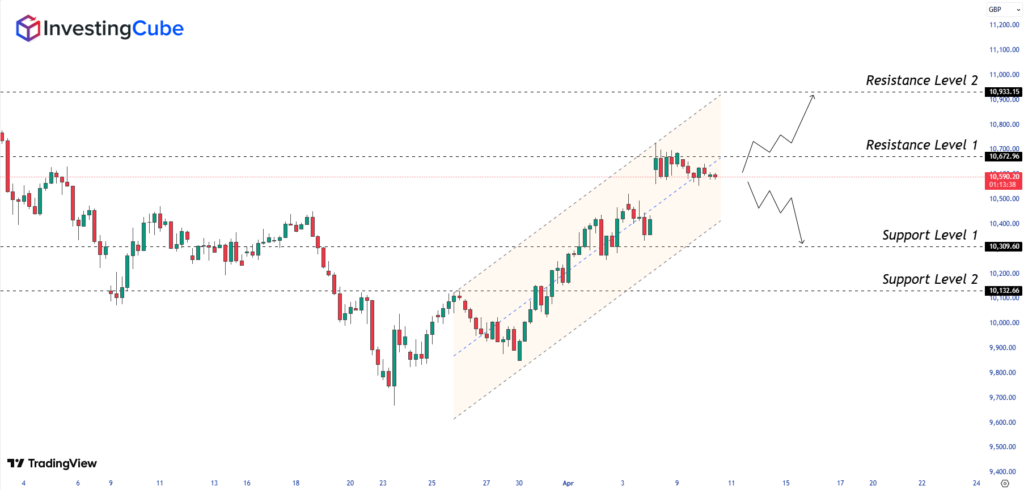
In the immediate term, a volatile consolidation seems much more probable than just an outright breakout. The FTSE 100 remains well-supported in energy and defensive names, which should limit sharp downside unless oil spikes aggressively or yields pick up materially.
At the same time, the index has already shown earlier signs of giving back post-relief rally gains, indicating that buyers are less inclined to chase higher prices without new confirmation.
The other part of the bullish case today would be for geopolitical tensions to remain contained and inflation concerns ease. In this scenario, the FTSE 100 might retest this week’s peaks. The bearish case is continued doubts over the ceasefire, a further extension of oil’s rebound, or upside surprises in US CPI that may yank the index back into a more defensive range.
Final View
The FTSE 100 price prediction today will be neutral to bearish. While the index remains underpinned by its sector mix, the easiest part of the bounce is likely already behind it. Unless geopolitical risks keep fading and inflation data cooperate, however, upside follow-through is likely to be limited. For the time being, the FTSE 100 is more likely to remain headline-driven and range-bound than engage in a sustainable bull move.
Frequently Asked Questions
Because the earlier relief rally was driven by optimism over a US-Iran ceasefire, but that support weakened as investors began to question how durable the truce really is.
Its sector mix helps. The index has large energy, mining, banking, and defensive healthcare names, which can provide support when oil and commodity prices rise.
The next big driver is likely US CPI. A hotter inflation reading could push yields higher and weigh on equities, while a softer number could support risk appetite and help the index stabilize.