


- The index is currently acting as a "geopolitical hedge," where losses in the broader market are being offset by the massive profit boost for energy giants like Shell and BP due to rising oil prices.
- Traders are focused on the 10,480–10,557 support zone; holding this level is essential to prevent a deeper slide toward 10,188 if the Israel-Lebanon strikes escalate further.
Investors turned more cautious after Israel struck Lebanon and Iran reclosed the Strait of Hormuz. Concerns about energy supply kept the market on edge. Therefore, the FTSE 100 index dropped 19 points in early trades, reaching the 10,590 level. The European market also dropped, such as Germany’s DAX, which is down 0.8%, and France’s CAC, which is 0.5% lower.
Israel’s strikes on Lebanon fueled the price of Brent crude oil to jump back up toward $98. Meanwhile, the FTSE 100 is heavily concentrated on oil giants, propping it up, resulting in a drop that was less than that of the European market.
Because the FTSE 100 is home to oil giants like BP and Shell. Those stocks acted as a shield, preventing the index from dropping sharply. However, the index is losing points because of war fears; it’s gaining them back because those same fears are driving up the value of its big energy sector.
The FTSE 100 Technical Outlook | Key Levels to Watch:
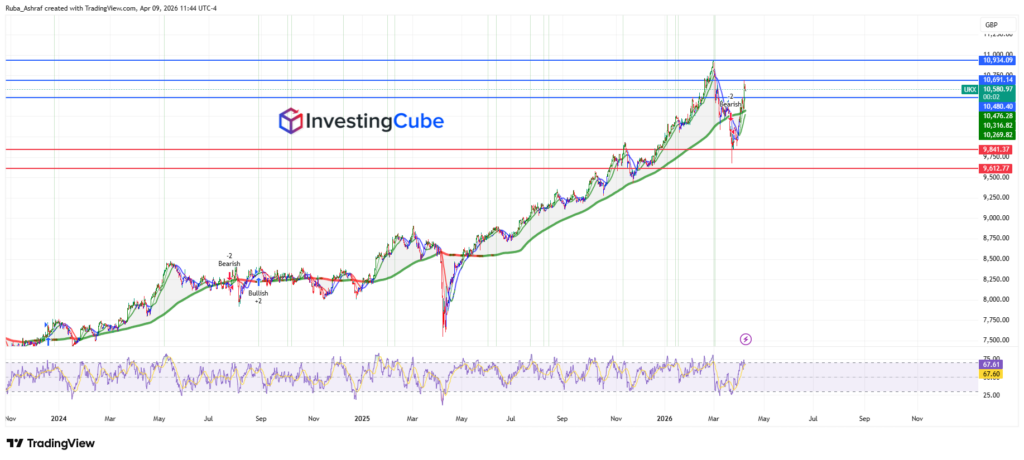
The chart shows that the FTSE 100 has been in a strong and sustained uptrend over the past few months. It formed consistently higher highs and higher lows while holding above the long-term moving average. The trend accelerated further as prices pushed into new highs near the 10,900–11,000 resistance zone, where sellers started to step in.
At that point, the index faced a sharp rejection, forming a noticeable pullback from the highs. This move suggests profit-taking and the start of a short-term correction after an extended rally. Additionally, the two-week ceasefire agreement between the US and Iran also drives this drop. While this agreement drove oil prices down, the FTSE 100 entered a correction phase and traded lower.
The drop briefly broke below short-term support levels, but the price quickly found support around the 10,050–10,100 area, which aligns closely with the rising moving average. This indicates that the broader trend remains intact despite the recent volatility.

Currently, price is attempting to recover and stabilize above this key support zone. The rebound shows that buyers are still active, but the index is now trading below immediate resistance around 10,550–10,700.
In a bullish recovery scenario, the index holds its current floor and successfully breaks above the 10,691 resistance, which would likely be triggered by positive progress in the Islamabad peace talks or a cooling of regional tensions. This would pave the way for a retest of the 10,934 peak.
Alternatively, we may see a sideways consolidation, where the price remains trapped in a “wait-and-see” range between 10,480 and 10,691. Overall, the FTSE 100 remains in a broader uptrend, but the recent rejection from highs signals a temporary pause.
The FTSE 100 has a defensive structure compared to other global indices. Energy giants like Shell, BP, and mining companies heavily weigh the index. While war fears generally hurt the stock market, the resulting spike in oil prices provides a massive profit boost to these specific companies, which helps “shield” the overall index from deeper losses.
High interest rates are a “double-edged sword” for the FTSE 100. On one hand, they strengthen the U.S. Dollar, which is actually good for the index since about 75% of FTSE 100 revenues are earned abroad and then converted back into a weaker Pound.
On the other hand, if rates stay high for too long to fight war-driven inflation. It can hurt the “domestic” side of the index, such as housebuilders and retail banks, as borrowing costs become too expensive for consumers.