



- The USD/INR forex pair has risen to historic highs, defying the assumption that cheaper Russian oil could buffer the rupee
- Foreign Institutional Investor outflows are adding to the demand for the US dollar, further favouring USD/INR upside
- The Reserve Bank of India has spent about $15 billion in March alone to limit the rupee's slide, but a longer conflict in the Middle East means that strategy may not prevent further gains by the dollar
The Indian rupee shouldn’t be this weak. India started 2026 with more protection from outside shocks than most emerging markets. It had access to cheap Russian crude, a strong economy that was driven by domestic demand, and one of the largest foreign exchange reserves in the world.
But here it is. The USD/INR pair reached its highest point ever this week, 94.40. The rupee has also lost almost 9% of its value against the dollar this financial year, which is the biggest drop in value since 2013–14. So what is going on, and why isn’t the Russian oil lifeline providing more relief?
Why the Russian Oil “Shield” is Faltering
It’s reasonable to ask why the rupee remains under pressure despite sourcing discounted Russian crude. The reality is that while Russian oil provides a vital buffer, it only accounts for a portion of India’s total energy needs. When global benchmarks like Brent jump close to 120 dollars a barrel, the math gets ugly fast. So despite savings on one front, the bigger picture stays shaky.
There is also a geopolitical factor at play. The US granted India a 30-day waiver in early March allowing the purchase of approximately 20 million barrels of Russian oil that were shipped before sanctions. But this waiver expires on April 11, and US signals suggest India should switch to American crude. This creates medium-term uncertainty regarding supply and costs, which markets are factoring into the rupee’s valuation. In this context, Russian oil offers some relief but does not fully shield the currency.
Additional pressure comes from capital outflows. Foreign Portfolio Investors withdrew over $11 billion from Indian equities and debt in March alone, the largest monthly outflow since October 2024. When foreign investors exit, they sell rupees and buy dollars, directly weakening the currency.
A broader macroeconomic element is the global strength of the US dollar, supported by elevated oil prices. Higher oil costs have diminished expectations for Federal Reserve rate cuts in 2026, strengthening the dollar and, by extension, putting downward pressure on the rupee.

The RBI’s High-Stakes Defense
The Reserve Bank of India (RBI) has not been a silent observer. In March alone, the central bank has deployed an estimated $15 billion to defend the rupee. Thanks to these moves, the currency avoided steep drops, unlike Thailand’s baht or South Korea’s won, which fell 5%-6%. The rupee stayed on firmer ground because of it.
However, the effectiveness of these measures has limits. According to Gaura Sen Gupta, chief economist at IDFC First Bank, maintaining rupee stability will require significant ongoing intervention. If the crisis is prolonged, preserving reserves becomes the priority. The RBI is managing volatility, not reversing the trend.
USD/INR Forecast
USD/INR RSI on the daily chart stands at 71.87, signaling that the bullish conditions are reaching extreme overbought territory. The first resistance appears at 94.21, just outside the upper Bollinger Band on the daily chart. A break past that could send the pair higher to test 94.50. Going below 93.65 pivot will shift the momentum to the downside, with immediate support at 93.36, and a stronger backing at 93.00.
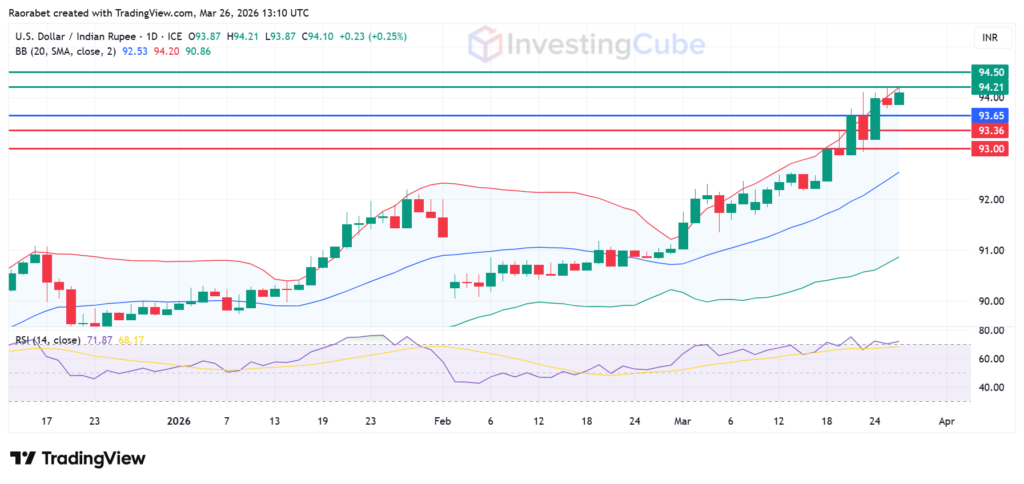
USD/INR on the daily chart showing the key support and resistance levels on March 26, 2026. Created on TradingView
Russian oil lowers India’s cost of imports but does not reduce dollar demand. Meanwhile, $11 billion in FPI outflows, a Hormuz-driven oil surge, and Fed rate-cut cancellations are overwhelming that partial insulation.
Interventions have limited sharper declines and triggered short-term rebounds by curbing speculation. However, they have not reversed the broader 4% year-to-date weakening, as external oil and risk factors remain dominant.
The RBI is estimated to have sold over $15 billion in March 2026. While this has helped the rupee outperform other Asian currencies, it has caused a significant weekly decline in India’s total foreign exchange reserves.