



- EUR/USD is under immense pressure from combined forces of rising crude oil prices and a dollar-centric interest rate differential
- The Federal Reserve is expected to keep interest rates elevated, while the European Central Bank is unlikely to lower interest rates, so as to tackle inflation
- A sudden news of cessation of hostilities in the Middle East could strengthen the euro, but extensive damage to oil infrastructure means oil prices will likely stay expensive for a while
The euro is going through a tough time right now. As of March 30, 2026, the EUR/USD pair has lost value for the fourth day in a row. The pair reached a local high of 1.1640 last week, but during today’s European session, it has moved back near the 1.1490 level.
The Iran War Is the Story the Euro Cannot Escape
The Iran conflict remains a significant factor influencing the euro’s performance. Ongoing tensions in the Middle East, particularly concerning Iran, have contributed to rising oil prices and brought additional uncertainty to Europe’s energy supply. Given the Eurozone’s reliance on energy imports, this situation impacts its economy more noticeably than that of the United States, complicating the balancing act policymakers face between growth and inflation.
Monetary policy differences between the US and Europe also contribute to the current situation. While the Federal Reserve has kept interest rates steady around 3.5–3.75%, with no immediate expectations of cuts, the European Central Bank has maintained a more cautious stance despite inflation risks fueled by energy costs. This divergence creates a yield gap that favors dollar-denominated assets, reinforcing the downward trend in the EUR/USD pair.
What Will It take for EUR/USD to Rebound?
For the euro to stabilize, two conditions are essential. First, a reduction in Middle East tensions would help ease the war premium embedded in the dollar, with reopening the Strait of Hormuz potentially providing swift relief. However, damage to regional infrastructure suggests that elevated oil prices may continue for some time.
Second, the forthcoming German HICP inflation data must indicate that inflation pressures are moderating without severely restricting industrial output. Without these developments, the likelihood is that the euro will continue to face downward pressure.

EUR/USD Forecast
The EUR/USD RSI on the daily chart at 39.40 points to a bearish bias without being in oversold territory, suggesting further downside room remains. The pivot is at 1.1535 and action below that level favours the sellers to be in control. Key short-term support is at 1.1484. A decisive close beneath this level would open the door to 1.1440 and ultimately the March swing low near 1.1400. On the resistance side, the Volume Weighted Moving Average at 1.1573 is the immediate ceiling traders have repeatedly defended, with 1.1614 likely to be the second resistance.
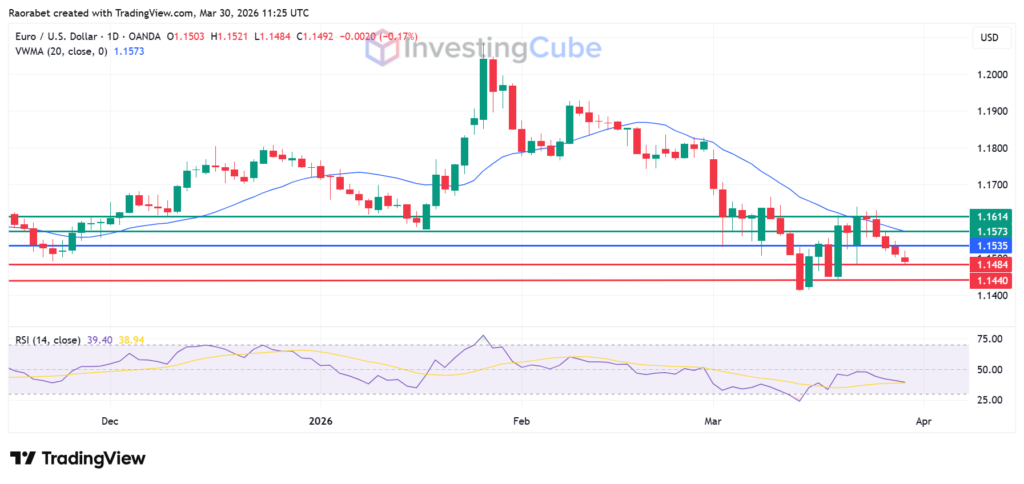
EUR/USD daily time frame chart showing the key levels of support and resistance on March 30, 2026. Created on TradingView
The dollar has stayed strong because of rising energy costs due to geopolitical tensions in the Middle East and a widening yield gap between the US and the Eurozone due to the Fed’s prudence and the ECB’s dovishness. This double pressure has had a direct effect on EUR/USD.
A credible ceasefire or diplomatic breakthrough in the US-Iran conflict. Oil prices would fall immediately, the energy inflation premium embedded in the dollar would decompress, and the ECB rate hike expectations driving euro volatility would quickly be repriced lower.
High energy prices act as a tax on the Eurozone economy. Because Europe is a net energy importer, spiking gas and oil prices weaken its trade balance and weigh heavily on the euro’s valuation.