



- News of safe passage by some oil tankers through the Strait of Hormuz has reduced the US dollar's safe haven strength over the euro
- Both the Federal Reserve and the European Central Bank will make interest rate decisions this month, and the Fed is expected to hold rates steady
- The situation in the Middle East remains delicate and an escalation of risk in the Strait of Hormuz could reverse the euro's recent gains
The EUR/USD pair has spent much of 2026 in a clear downward channel, shedding more than 1.9% year-to-date and trading near multi-month lows below 1.15 for extended periods. But the pair made a big comeback, gaining 0.78% on March 16 and continued to rise slightly during intraday session on March 17, staying around 1.1510–1.1517. This change is a temporary break from the overall trend and calls for a closer look at what’s going on.
Middle East De-Escalation Signs and Interest Rate Posture Favour the Euro
Recent gains in the euro are largely driven by signs of reduced tensions in the Middle East. Reports indicate several tankers have passed safely through the Strait of Hormuz, and U.S. officials have suggested that Iranian oil exports might continue under specific conditions, alongside efforts to create an international coalition to safeguard shipping routes. These developments have eased immediate concerns about long-term supply disruptions.
As a result, demand for the U.S. dollar as a safe haven has reduced, moderating the oil price surge that had influenced market sentiment. This shift has modestly improved risk appetite, enabling the euro to regain some strength against the dollar.
Investors are also moving their money around in preparation for a key Federal Reserve meeting on Wednesday. There is a strengthening case for the European Central Bank (ECB) needing to raise rates to fight the energy-driven inflation shock, even though the Fed is expected to keep rates the same. This possible difference in policy is giving the euro the traction it needs to go up.
If the ECB proceeds with rate hikes, it would alter the interest rate differential in favor of the euro and could quicken the EUR/USD pair’s recovery toward the 1.20 mark sooner than many forecasts anticipate.

EUR/USD Forecast
The daily EUR/USD RSI has gone up from below 30, where it was oversold, to the high 30s. That doesn’t mean the momentum has changed yet, but the pair is no longer falling freely. The first major hurdle is at the 10-day EMA at 1.1566. A daily close above this could open the door to 1.1635. On the downside, initial support emerges near 1.1466, with a clear break potentially exposing sub-1.1400.
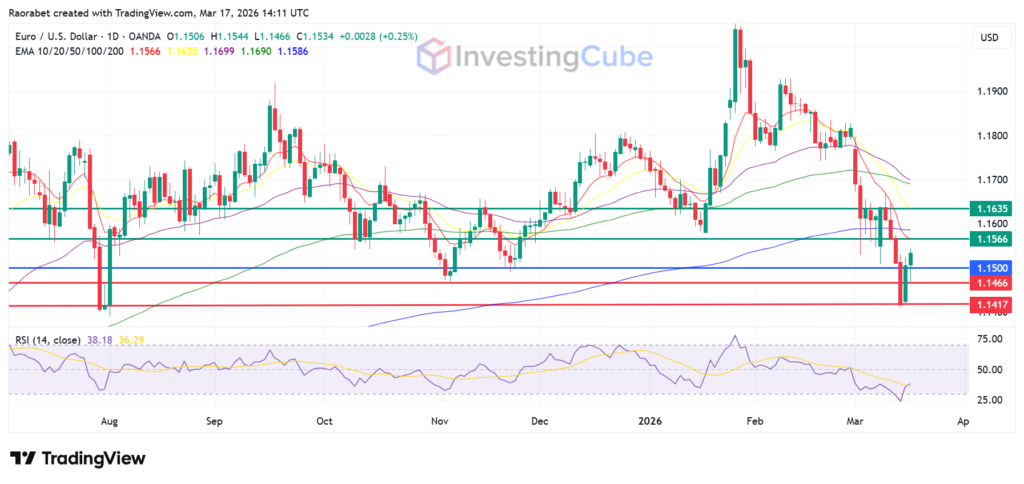
EUR/USD FX pair on the daily chart with key levels of support and resistance. Created on TradingView on March 17,2026
The gain was largely driven by a de-risking move as oil prices stabilized and tensions in the Strait of Hormuz eased, causing the U.S. dollar to retreat from its 10-month highs.
The Euro is more sensitive to energy shocks because the Eurozone imports most of its oil. Rising prices hurt European growth more than the U.S., which is often seen as an energy-independent safe haven.
It could go on for longer if tensions ease even more, but ongoing oil risks and central bank signals could halt gains and start the downtrend again.