



- AUD/JPY is currently on a downtrend as the momentum shifts from oil to safe haven needs
- The Reserve Bank of Australia held rates in its most recent review, while the Bank of Japan is expected to raise rates in April
- China's manufacturing activity is strained, as indicated by a decline in the PMI in March
Since mid-March 2026, the AUD JPY currency pair has moved mostly downward, marking its first sustained reversal after a long climb starting August 2025. After nearly seven months of steady gains, this drop hits hard for traders who bet on rising returns. So, why is the Yen suddenly finding its feet?
Where Has the Yen Been Getting Its Momentum from?
The recent strength in the yen largely reflects its traditional role as a safe-haven currency amid geopolitical tensions. As conflict intensified in the Middle East and concerns around the Strait of Hormuz grew, investors sought the yen for its liquidity and relative stability despite low yields.
For a long time, the Japanese yen was viewed unfavorably in the markets, but this perception is changing. A key factor is the Bank of Japan’s (BoJ) decision to hold interest rates steady at 0.75% during its March 2026 meeting. Although this rate remains low by international standards, it represents the highest level since 1995.
Is the Downtrend Sustainable?
Sustainability in the near term is plausible if geopolitical risks remain elevated or escalate further. The yield differential between the Reserve Bank of Australia (RBA) and the BoJ still favours the Australian dollar in theory, yet risk-off sentiment has repeatedly trumped this carry-trade logic.
Challenging the consensus that higher oil should automatically reverse the pair’s decline, the yen’s safe-haven status has proven more influential during the current conflict. Any meaningful de-escalation or stabilisation in oil prices could allow AUD/JPY to stabilise or rebound, but until then the downtrend may persist.
The yen is reclaiming its status as a safe haven not just because of its low volatility, but because Japan’s trade balance is proving more resilient to global chaos than expected. This makes the current downtrend more than just a technical correction; it’s a structural re-rating. Unlike during the 2022 Ukraine conflict, inflation pressures now spread faster across Japanese industries. Should April bring a rate hike by BoJ, that move could anchor stronger fundamentals behind the yen, pushing the AUD/JPY pair even lower.

Also, when China sneezes, Australia feels it. As the top buyer of Aussie exports, its slowing factory activity, with manufacturing PMI declining to 50.8 in March, weighing on the Australian dollar. That ripple hits AUD/JPY hard when Asia stumbles.
AUD/JPY Forecast
The AUD/JPY’s RSI around 44 signals a downward-centric momentum. The immediate support level is near 109.67, with a more significant demand zone at 109.11. An upside momentum would need the pair going above 110.33. That would likely have the first resistance at 110.64, with the second one coming at 110.
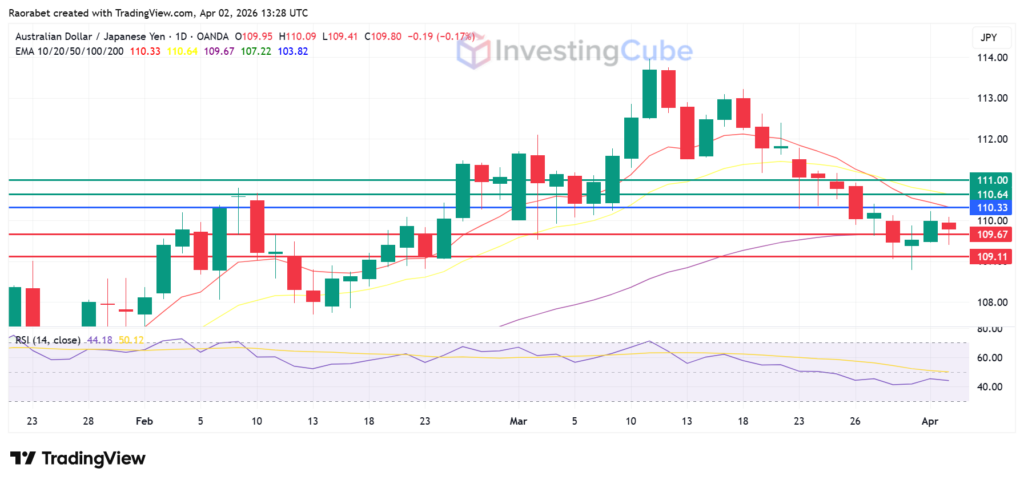
AUD/JPY performance on the daily chart with the key support and resistance levels on April 2, 2026. Created on TradingView
Despite Australia’s higher interest rates, the narrowing differential compared to Japan encourages investors to repatriate capital to Japan, thereby strengthening the yen.
It has made people less willing to take risks, which is good for the yen, and it has broken the typical commodities correlation. The yen’s defensive properties have been stronger than expected during this time.
A sustained downtrend is unlikely at this point. While we are in a reversal since August 2025, Japan’s rates are still low by global standards. Most analysts view this as a healthy correction rather than a total collapse.