



- A hawkish hike by RBA to 4.10% has given the Australian dollar a carry trade advantage , with Japan's interest rate at 0.7%
- The Japanese yen's safe haven status has been eroded by the sharp spike in fuel prices due to Japan being among the top fuel importers
- Stable commodity prices have added support to AUD/JPY as Australia's main customer, China stays resilient
The AUD/JPY forex pair experienced a gradual decline from mid- to late March 2026 but has since regained momentum in April, rising approximately 0.7% over the past five trading sessions. This rebound prompts an examination of the factors behind the shift from earlier weakness.
Where Is the Australian Dollar Getting Its Strength From?
The Australian dollar’s recent resilience stems from a mix of stronger commodity prices and encouraging domestic economic indicators. After a period of volatility, prices for iron ore and coal have steadied, which supports Australia’s export revenues.
Recent Reserve Bank of Australia (RBA) communications have reinforced expectations of a cautious approach to rate cuts. Surprising to some, the RBA stayed firm while others eased up. Instead of lowering rates like peers hinted at, officials pushed Australia’s cash rate higher, hitting 4.10% by end-March, according to official figures. That move gave the Aussie dollar a boost. Markets started warming again, lifting confidence along with the currency.
The Yen’s Vanishing Act as a Safe Haven
A notable development is the Japanese yen’s sudden decline as a safe haven currency. Typically, geopolitical tensions such as the recent unrest in the Middle East, prompt a surge in the Yen. However, in April 2026, the yen has weakened toward 160 against the USD and faced softness against the AUD.
This shift is largely due to Japan’s status as a net energy importer. With oil prices around $110 per barrel, Japan is effectively incurring significant expenses to maintain energy supplies. Analysts at Oanda point out that these higher crude costs are increasing stagflation concerns in Japan. The yen struggles to serve as a refuge when the very issues driving market uncertainty are simultaneously worsening Japan’s trade deficit. Moreover, ongoing policy adjustments by the Bank of Japan have diminished the Yen’s appeal as a funding currency for carry trades.

AUD/JPY Forecast
The RSI on AUD/JPY reads 52.38, indicating control by buyers. The pair faces its first major hurdle at the Volume Weighted Moving Average (VWMA) level at 111.13, with the next one being a psychological round figure barrier at 112.00. Immediate support sits at 109.67, with a more structural floor at 109.00.
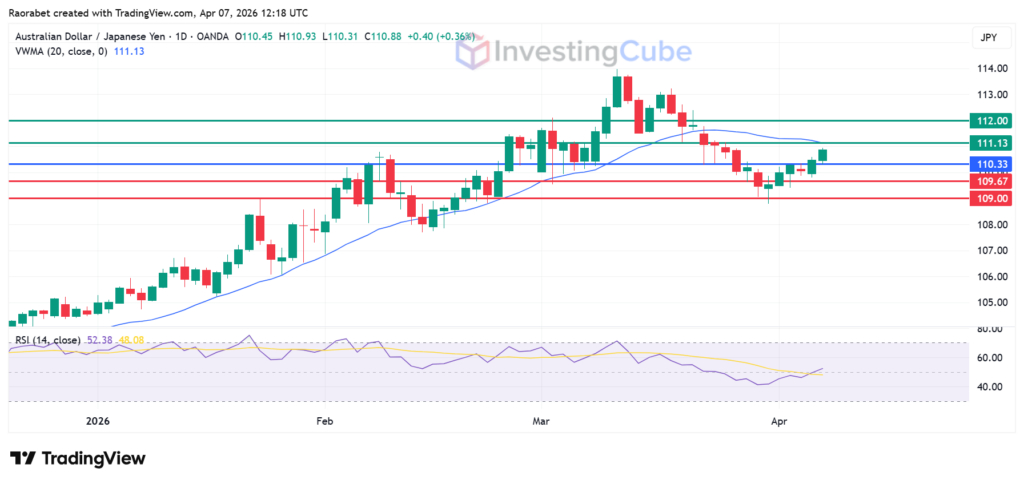
AUD/JPY daily chart with the key levels of support and resistance on April 7, 2026. Created on TradingView
Japan’s heavy reliance on imported energy means high oil prices weigh on its economy, overshadowing the yen’s usual safe haven support. The increased cost of imports raises concerns about stagflation, reducing demand for the currency even during times of market uncertainty.
Australia’s role as a commodity exporter means rising prices for resources like coal, gas, and metals improve its trade balance, lending support to the AUD. Conversely, Japan’s dependence on these imports puts pressure on its trade balance and the yen, leading to upward movement in the AUD/JPY rate.
The recent gains could be sustained in the short term if risk appetite remains healthy and commodity prices stay stable. However, potential reversals could arise, given the underlying factors of differing yield spreads and central bank policies.