
- The Middle East war initially pushed the AUD/JPY pair up due to Japan's high oil import bill, but the tide turned to favour the yen in March
- AUD's strong attachment to commodities has brought it pressure amidst the war, with investors preferring the yen's safe haven cushion
- Interest rate differentials between the BoJ and RBA is still substantial and carry trade attraction is still in place, although reduced
The AUD/JPY pair, often dubbed the “risk barometer” of the forex world, has hit a turbulent patch. After touching multi-year highs near 113.40 earlier in March, the pair has lost about 1.3% over the last week, retreating toward the 111.20 level. For a pair that usually thrives on stability and high-interest differentials, this sudden pivot has left many traders wondering if the “carry trade” party is finally winding down.
What’s Dragging Down the Aussie?
A drop like this usually follows a shift toward safer bets. Even though the Reserve Bank of Australia lifted rates by 25 basis points, bringing them to 4.10% on March 17, the AUD didn’t gain strength. Instead, it stayed flat.
Simultaneously, tensions in the Middle East gave the yen a sharp push. The US-Israeli strikes on Iran on February 28 initially sent the yen lower, with Japan’s status as a near-total oil importer making it vulnerable to energy price shock. Yet by March, something shifted. As fears settled into lasting instability, investors started seeing the yen as shelter again, lifting it steadily. What looked temporary turned persistent, pulling money back.
The market is currently more obsessed with safety than yield. As the US-Israeli conflict with Iran escalated, threatening to shutter the Strait of Hormuz, global equity markets took a hit. When investors are scared, they sell high-beta currencies like the AUD and buy havens like the Japanese Yen.
Also, even though the RBA raised rates, the Bank of Japan (BoJ) has said that they are holding stable for now because of uncertainties over the conflict. However, they are still open to raising rates to 0.75% or higher in 2026. The yen is becoming more appealing since this difference is getting smaller.
Is the AUD/JPY Carry Trade Dead?
The AUD/JPY carry trade is not yet dead, but it’s becoming expensive. A carry trade works best when volatility is low. Currently, the interest rate differential, which stands at about 400 basis points between the RBA’s 4.10% and the BoJ’s 0.10%, still supports the trade structurally.

However, recent spikes in volatility, reflected in VIX-like indicators, mean that gains from interest rates can be quickly offset by adverse price movements. While institutional investors may continue to hold long positions in AUD/JPY over the long term, retail traders face less favorable reward-to-risk conditions.
The balance of risks currently tilts modestly bearish for AUD/JPY into April. Continued tensions in Iran are likely to suppress global risk appetite and encourage intermittent safe-haven flows into the yen. As a commodity-linked, risk-sensitive currency, the Australian dollar tends to come under pressure during such episodes.
| Factor | Current State | Direction | Carry Impact |
|---|---|---|---|
| RBA Cash Rate | 4.10% | Nearing terminal rate | Narrowing |
| BoJ Policy Rate | 0.10% | April hike possible | Narrowing |
| AU–JP 10Y Yield Spread | ~2.66% | Structurally elevated | Supportive |
| Global Risk Sentiment | Risk-off | Iran war ongoing | Negative |
| Iron Ore Price | ~$120/tonne | Stable but watch China | Supportive |
| BoJ Intervention Risk | Elevated (above ¥159 USD/JPY) | Ministry of Finance verbal warnings | Negative |
AUD/JPY Forecast
The pair has dropped below its Volume Weighted Moving Average (VWMA) and has its first key support at 110.90. A sustained break below would expose the 110.00 psychological handle. On the upper side, immediate resistance is at 112.54. If the price closes over that mark, on a daily basis, it might make a move to test 113.66.
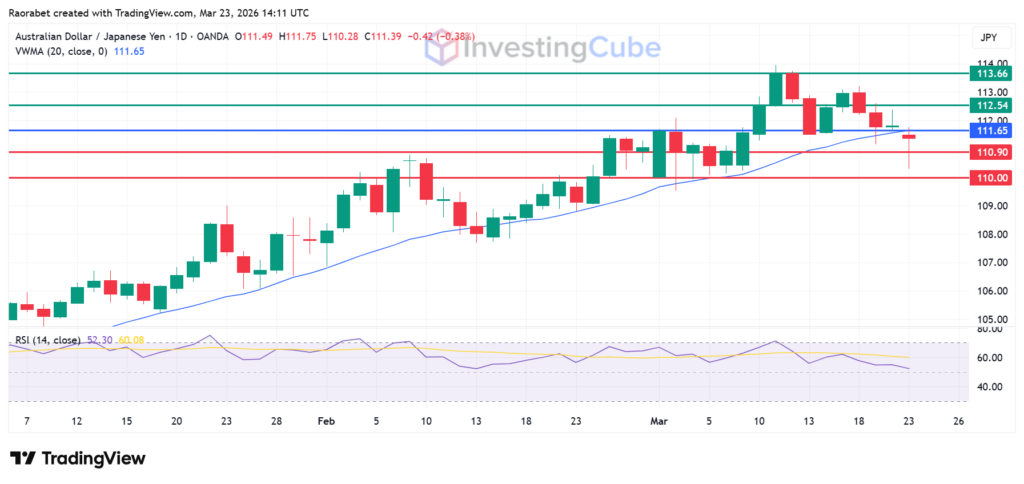
AUD/JPY daily chart with the key levels of support and resistance on March 23, 2026. Created on TradingView
While the RBA hike to 4.10% was bullish, it was overshadowed by “risk-off” sentiment. Geopolitical tensions in the Middle East led traders to favor the safety of the Yen over the higher-yielding Australian dollar.
Carry trades are risky right now because of how volatile the market is. The difference in interest rates is substantial, but the risk of losing money because of yen safe-haven gains is also considerable. It’s best to wait till things are less volatile.
It could materially compress it. If the BoJ hikes to 0.25–0.50% while the RBA holds, the differential narrows from both ends simultaneously. A rate hike plus yen safe-haven demand is AUD/JPY’s most dangerous combined scenario.