


- The TAIEX is currently at a critical junction; holding the 31,995 support level is essential to confirming that the recent correction was a temporary pause before a new bullish rally.
Looking back over the past four years, you’ll find that Taiwan’s stock market has outperformed Japan’s and South Korea’s. It was driven by strong growth in artificial intelligence (AI) hardware, a particular strength of Taiwan’s economy.
In 2022, TAIEX surged about 120%, rising from 12,666 to 27,867 by Dec 15. TAIEX’s gains outperformed other major Asian indices. They exceeded the 103% rise in Japan’s Nikkei 225 index and the 89.9% increase in South Korea’s KOSPI Composite Index.
Taiwan delivered a standout economic performance in early 2026, fueled by its central role in the AI hardware supply chain. While the ‘Trump 2.0’ era introduced tariff concerns and currency fluctuations, a recent bilateral trade deal has mitigated these risks. With GDP growth forecasted at 7.7%, Taiwan has reclaimed its status as a top-tier Asian tiger, matching the growth momentum typically seen in emerging powerhouses like India and Vietnam.
Taiwan’s per capita GDP is expected to rise to USD 38,000. This surpasses Japan and South Korea for the first time in history. The Taiwan index (TAIEX) managed to reach high levels and outperformed its peers in Asia by the start of 2026.
After reviewing Taiwan’s economic growth over the past four years, let’s now take a technical look at its benchmark index, the TAIEX.
Taiwan Index (TAIEX) Technical Outlook:
The provided chart illustrates that the TAIEX has a clear transition from a sustained bullish channel into a volatile consolidation phase.
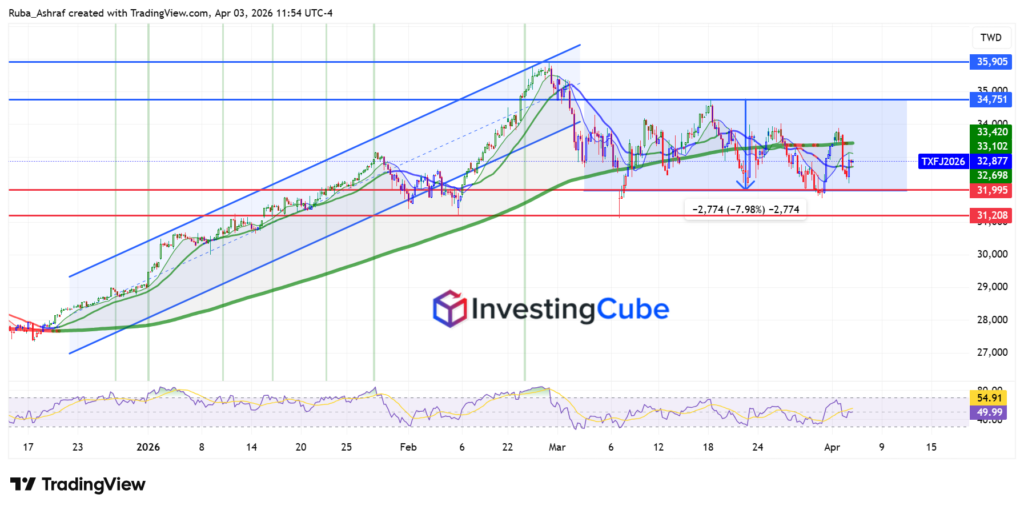
From late 2025, the index followed a strictly defined ascending channel, peaking near 35,905. However, a sharp correction in March broke this trend. It leads to a drop of approximately 7.98%.
The price is currently fluctuating within a specific price range. The support level is 31,995, and the resistance line is 34,751. The green horizontal line at 33,102 acts as a “pivot” or middle ground where the market is currently fighting for direction.

The flattening green moving average line confirms a sideways trend. The RSI is standing near 50, indicating a neutral momentum where neither buyers nor sellers have clear control.
Scenario 1: The Bullish Recovery driven by AI Momentum & Trade Stability
This scenario assumes that the index will hold above the major support level at 31,995, using the current consolidation phase as the turning point and printing a further bullish trend. This would likely be driven by strong Q1 earnings from the semiconductor sector, such as TSMC. Moreover, the continued optimism regarding U.S. tariff exemptions for tech hardware.
Technically, if the index breaks above the 33,420 level with high volume, it signals that the correction is over. The target would be a retest of the 34,751 resistance. A sustained break above this level could pave the way to a rally back toward the psychological 35,000 mark as investors rotate back into growth stocks ahead of summer.
Scenario 2: The Bearish Correction Driven by Geopolitical Risk
In this scenario, the recent breakdown from the ascending channel is viewed as a major structural change. The current sideways is a “bear flag” before further decline. If geopolitical tensions in the Middle East escalate or the New Taiwan Dollar (TWD) faces unexpected volatility, the index could break below the critical 31,995 support.
A breach of this floor would likely trigger a rapid sell-off toward the next psychological and technical support at 31,208. This would confirm a short-term “bear market” phase, characterized by lower highs and lower lows, as institutional investors hedge against global macroeconomic uncertainty.
Taiwan is currently benefiting from a unique “AI Supercycle.” Unlike many mature economies, it focuses heavily on semiconductor manufacturing. This allows Taiwan to capture a direct share of global AI infrastructure spending. As a result, GDP growth is projected to reach 7.7%.
In early 2026, a major trade agreement cut US tariffs on Taiwanese goods from 20% to 15%. Combined with ongoing semiconductor exemptions, this eased the “tariff anxiety” of 2025. The move created a more stable environment for foreign institutional investors to return to the market.