


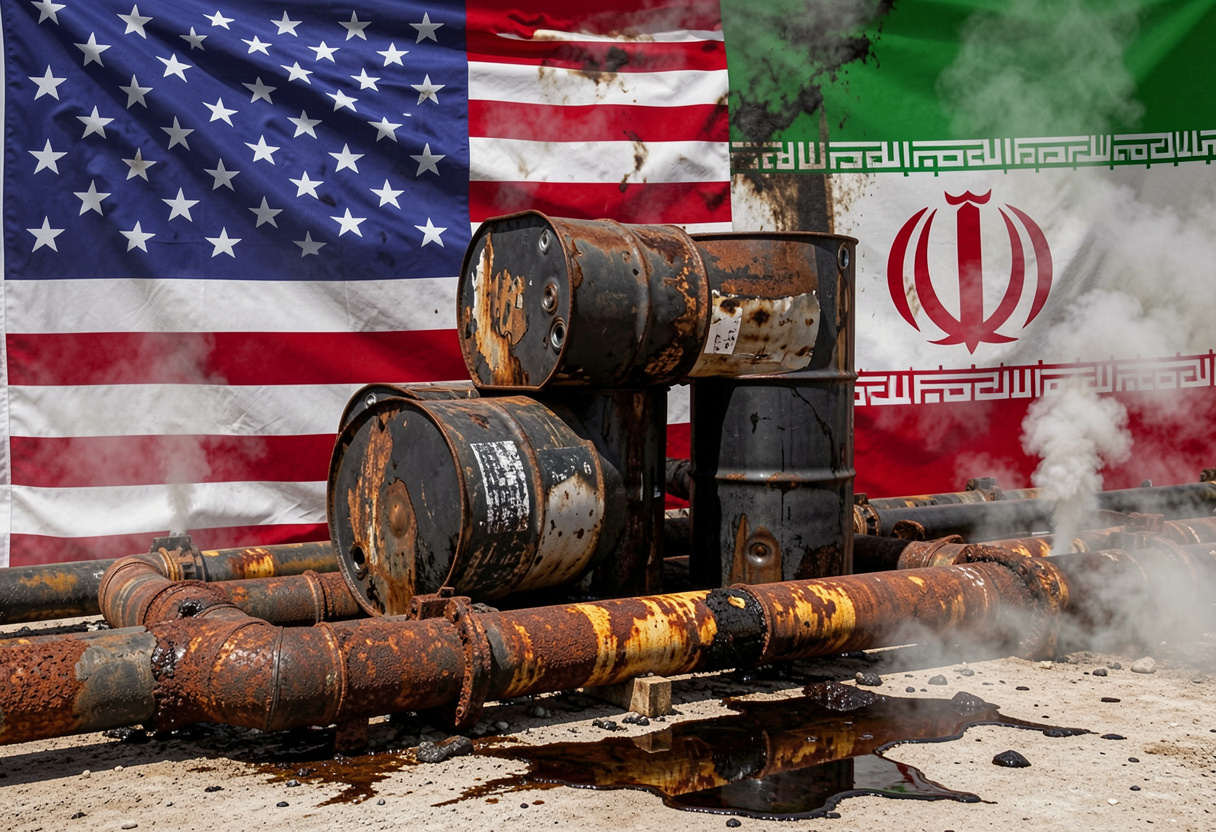
- Delve into the conflicting signals between Trump and Iran, analyzing Brent Crude Oil's technicals of resistance levels and potential recovery.
After U.S. President Donald Trump swore that the U.S. military would do more aggressive strikes on Iran. This let hopes for an end to the Middle East war disappear. Therefore, crude oil prices surged and went sharply up, intensifying the energy crisis and high energy costs to consumers around the world.
Moreover, the fears of supply disruption have risen amid the ongoing escalation in the US-Iran war. Especially after Iran has shown its ability to close the vital Strait of Hormuz, targeting oil tankers and attacking Gulf countries that host U.S. troops. Therefore, oil prices would continue rising and weighing on energy costs for global consumption.
Additionally, the International Energy Agency (IEA) said that supply issues could start negatively affecting Europe’s economy as early as April. He explained Europe had been protected so far by oil shipments secured before the conflict began. But unfortunately this support may now start to fade.
Conflicting Signals: Trump’s Statements vs Iran’s Response:
During a prime-time speech on Wednesday, Trump said:
We’re going to hit them extremely hard over the next two to three weeks. We’re going to bring them back to the Stone Ages where they belong.
Confirming that the U.S. military would achieve its military objectives soon. Apart from that, he warned that if Iranian leaders don’t agree to US demands during negotiations, he would strike on Iran’s energy and oil infrastructure.
He indicated a willingness to settle the conflict through a negotiated deal. At the same time, he told nations that depend on fuel shipments through the Iranian-blocked Strait of Hormuz to simply “just grab it” by themselves.
In response to that, European and other nations refuse to help secure the strait without a ceasefire, so 40 countries met online Thursday to find their own way to restart shipping. However, French President Macron said, “It can only be done in consultation with Iran.”
Iran’s armed forces’ response to Trump’s comment came with a warning for the United States and Israel of:
more crushing, broader, and more destructive attacks in store.

The war will continue until the ‘permanent regret and surrender’ of Iran’s enemies.”
stated Ebrahim Zolfaqari, spokesperson for the Khatam al-Anbiya central headquarters. This declaration, carried by Iranian state media. It signals a refusal to compromise, likely driving up oil prices and increasing the risk of prolonged disruption in the Strait of Hormuz.
Brent Crude Oil Technical Outlook | Accessing Resistance and Recovery:
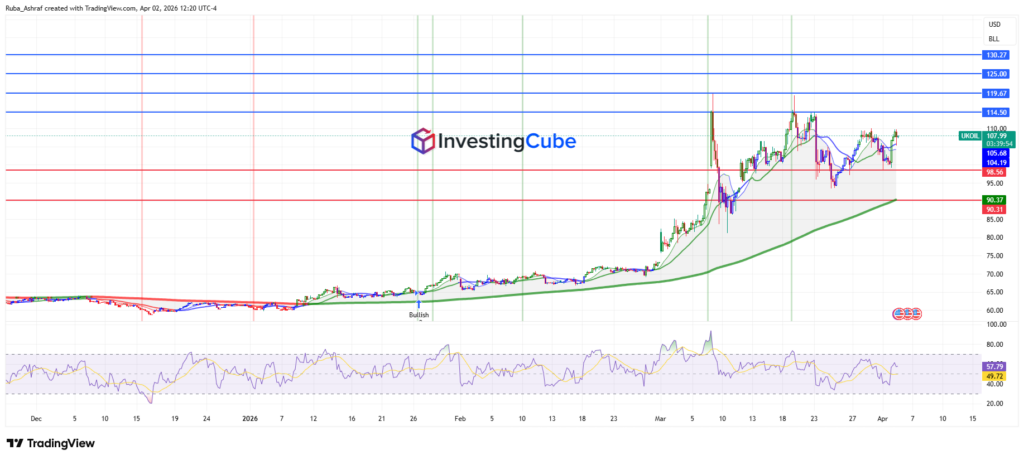
The provided chart for the Brent Crude oil price illustrates a significant bullish breakout followed by a period of high-level consolidation. After a relatively flat period in early 2026, the price underwent a vertical surge in March. This is driven by geopolitical escalations in the Middle East and the closure of the Strait of Hormuz.
Currently, the price is trading around $108.45, positioned within a tight cluster of resistance and support levels. The RSI indicator stands near 59.26, indicating that the positive momentum is cooling off from previous overbought conditions. This means that the price may enter a consolidation phase before going up further.
Scenario 1: Break Above Immediate Resistance
If the price successfully breaks and holds above the immediate resistance zone of $109.46 to $110.00 psychological barrier, it would signal a continuation of the bullish trend.
Technically, a daily close above the blue resistance line at $114.50 would pave the way to test $119.67 and potentially the 2022 highs near $130. This scenario would be fueled by further supply disruptions or a heightened geopolitical risk premium.
Scenario 2: Failure to Break and Bearish Reversal
Conversely, if the price fails to breach the $109.46, a “Double Top” pattern could begin to form, suggesting buyers losing momentum. A loss of momentum would likely see the RSI trend downward toward the 50 level. In this case, if the oil price falls toward the red support line at $104.15 without holding, a deeper correction would happen toward $98.56.
Such a reverse would likely be triggered by a “de-escalation” narrative or a shift in market focus toward the projected global supply surplus and OPEC+ production increases later this month.
The most important level to watch is the $110.00 psychological resistance. A break above this would likely trigger a move toward $114.50 or higher. On the other hand, failing to cross it could cause a price drop back toward the $104.15 support.
With the Strait largely blocked by Iranian attacks, a global standoff has emerged. While the U.S. has encouraged dependent nations to secure fuel shipments independently, international efforts remain stalled as many countries refuse to intervene without a formal ceasefire.