


- Escalating tensions in the Middle East are fueling a flight to the US Dollar and driving up oil-led inflation.
- A hawkish "higher-for-longer" Fed stands in sharp contrast to a cautious Bank of Japan, widening the yield gap.
- The structural bias remains bullish toward 162.00, though intervention risks near 160.00 warrant extreme caution.
USD/JPY continues to be stubbornly macro-driven with geopolitical tensions, central bank divergence and energy-led inflation risk dominated price action today. With market continuing to adjust on the latest from the Middle East as well as shifting perceptions around a Federal Reserve and BOJ (Bank of Japan) ,USD/JPY is coming down towards an important psychological inflection point shortly located around 160.
Fundamental Background
The US dollar rose sharply today in the wake of renewed geopolitical escalation. According to Reuters, USD strengthened after U.S. president Donald Trump indicated further military action against Iran, which has resulted risk aversion and moving into the dollar. The yen weakened toward the 160 mark, which is widely considered by analysts to be an intervention zone as investors flat to safety, while the dollar gained, Reuters reported.
At the same time, climbing oil prices — thanks for the conflict in the Middle East — are bolstering inflation worries around the world. Brent crude surged, according to reports, fueling concerns that Central Banks may have to maintain higher interest rates for a longer period.
This relationship is key for USDJPY: high inflation expectations in the U.S. should translate to higher treasury yields, which make the dollar attractive compared with low yielding currencies like yen.
On monetary policy, the Federal Reserve remains cautious but firm. A report from Reuters emphasized that Fed officials see nothing pressing right now to amend policy, implying rates will remain restrictive as inflation pressures show little sign of going away. This “higher-for-longer” position still lies behind the continue for USD strength.
The Bank of Japan finds itself in a more complicated situation. Although inflation is climbing on the back of rising energy cost and a weaker yen, policy makers are cautious about moving to tighten in a hurry. A BOJ board member cautioned that the Iran conflict may push Japan into stagflation, making decisions on policy more difficult.
The Reuters report added that Japan might have more to fear from supply disruptions than inflation, and aggressive tightening could hurt growth.
Despite some hot inklings, the BOJ is measured approach opens the door to a widening interest rate gap between the US and Japan — a twist that would continue to support USD/JPY upside.
Key Market Drivers
USD/JPY has three prevailing macro forces at play.
- Yield differential — with the US still being significantly higher than that of Japan, supports USD demand.
- Geopolitical Risk — Middle East tensions are pushing the dollar higher on safe-haven flows.
- Policy Divergence — Fed is restrictive, BoJ cautious and slow.
Importantly, the yen’s historical safe haven appeal has diminished in recent years. The yen’s traditional role as a safe haven in times of crisis no longer holds with regularity, as emphasized by an analysis from Reuters, mostly due to structural factors and yield disadvantages.
Technical Structure
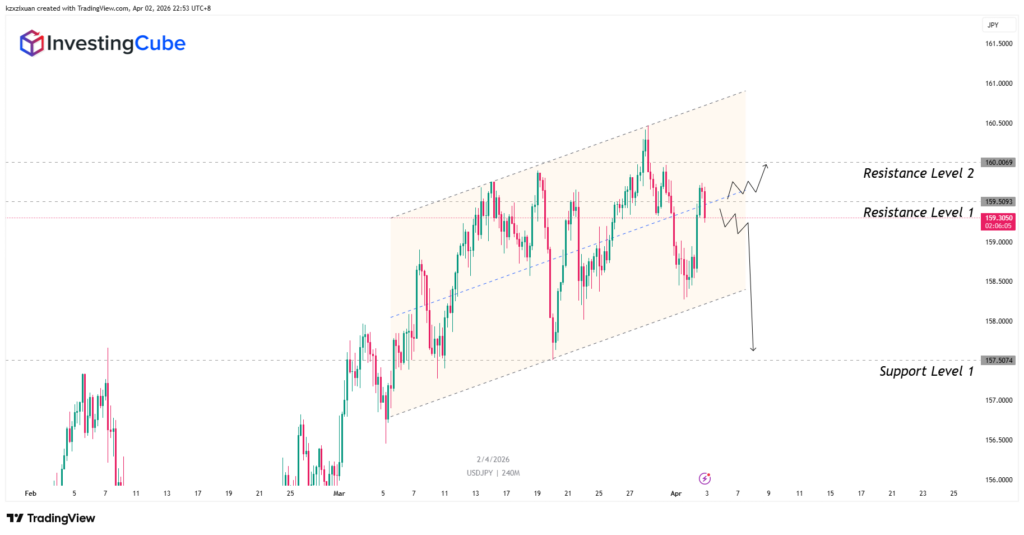
Despite it being a greenback day, USD/JPY is technically still on top with higher highs and higher lows for the medium to larger timeframes.

- Key Resistance: 159.50 – 160.00 (critical psychological and intervention zone)
- Immediate Support: 157.50
- Deeper Support: 155.00 – 154.00
That 160 level is a key area of interest. Market surveys show that a majority of economists anticipate intervention if USD/JPY finds its way to or above this level, making it an important inflection point.
The price action is currently ranging below resistance, suggesting pressure is building for the next move.
Today’s Outlook & Scenarios
Bullish Scenario (Primary Case)
In this case, maintaining geopolitical tensions with high US yields should see USD/JPY testing the 160 threshold. A sustained breakdown above this zone would trigger momentum buying, sending the pair towards 161.50 – 162.00. This scenario would be bolstered with strong US data, especially Non-Farm Payrolls .
Bearish Scenario (Risk Case):
Eyes are on the yen: Downside risk are mostly linked to Japanese intervention or a changing market sentiment. In that event if authorities interfere or global risk aversion shift to yen support, USD/JPY could find itself headed back towards 157.50, for the distant target of 155.00 on any subsequent downside momentum.
Range Scenario (Most Likely Short-Term):
With our proximity to the 160 barrier and event risk (NFP), USD/JPY is expected to be range bound between 157.50 to 160.00 in the near term as traders look for a confirmation on what will drive this market next from a macro standpoint.
Conclusion
USD/JPY is conceptually structural bullish, buttressed by robust USD fundamentals and higher for longer yield, but the pair is currently oscillating within the pivotal area that just might place upside momentum between a rock (intervention risk) and the hard place (positioning adjustment).
The overall bias remains bullish so long as the macro backdrop — Hawkish Fed, wary BOJ and geopolitical uncertainty — does not change. However, caution is warranted around the 160 zone as volatility should accelerate there.
Frequently Asked Questions
The 160.00 mark is a critical psychological barrier and a widely recognized “intervention zone.” Analysts and economists anticipate that if the pair sustains a move above this level, Japanese authorities may step into the market to buy yen and curb excessive weakness, creating a “ceiling” for the pair.
Conflict drives up oil prices and inflation worries, pushing investors toward the US Dollar as a safe haven and fueling expectations for higher US interest rates.