



- USD/INR eased after the RBI introduced measures to curb speculative FX activity.
- The rupee rebounded as traders unwound long USD/INR positions after the new RBI rules.
- Despite the pullback, high oil prices and foreign outflows still limit rupee strength.
Market Overview
USD/INR opened softer on April 6, as the Indian rupee continued its rebound following new measures from the Reserve Bank of India (RBI). The RBI clamped down on a speculative and arbitrage activity by putting a cap on banks’ net open FX position, as well as limiting some non-deliverable forward-linked business and banning the rebooking of canceled contracts, according to Reuters. Such steps forced traders to cover positions and supported the rupee’s recovery from weak levels scene late last month.
That policy change led sentiment to shift quickly. The Rupee rose to an intraday high of 92.79 on Monday before settling down almost flat at 93.06 per dollar, compared with previous close of 93.10, Reuters reported. While the closing leg was small, it finished off a big intraday bounce. It indicated that the RBI had, at least temporarily such one way dollar demand and quelled panic that had brought USD/INR to the 95 region just days before.
Why the Rupee Rebounded
The single biggest catalyst was not a broad improvement in India’s fundamentals, but rather a sharp adjustment in market positioning. The RBI moves were noteworthy as they had unwound arbitrage trades and alleviated offshore-linked pressure under stricter rules, reported Reuters. Specifically, those traders long USD/INR aggression were forced to cut in activity which temporarily squeezed the pair lower.
This is important because the rupee’s recovery was policy influenced and not purely organic. The market had previously been squeezed by oil shocks driven by war and intense risk aversion, but Monday’s move showed that Central bank meddling can also still break the monotonicity of price section when speculative pressures get too one-sided. That said, Reuters also highlighted that there is still offshore pressure clinging in existence so the RBI might have to do more if the existing measures were no longer effective.
Macro Background Still Caps Rupee Strength
Some bounce, yet the medium term backdrop for the rupee is fragile. The rupee’s earlier weakness was attributed by Reuters to a shock of war in Iran and a surge in energy prices that are especially negative for India as an oil importer. Brent crude has surged since late February, as foreign investors continued to liquidate Indian assets, Reuters also reported. Combined, these factors maintain a tough inflation and external balance outlook for India.
The April 8 policy decision of the RBI is now a key event to watch out for. The repo rate is widely seen as unchanged at 5.25%, so the market attention will be on tone of statement, and whether RBI gives any indication that it may further support the currency either through liquidity tools or via direct management, Reuters said. Economist cited by Reuters said that the central banks updated projections are likely to show a rougher path ahead with growth waning and inflation remain elevated if oil prices stay high. That mix does not bode for a firm or durable rupee recovery.
Technical Analysis
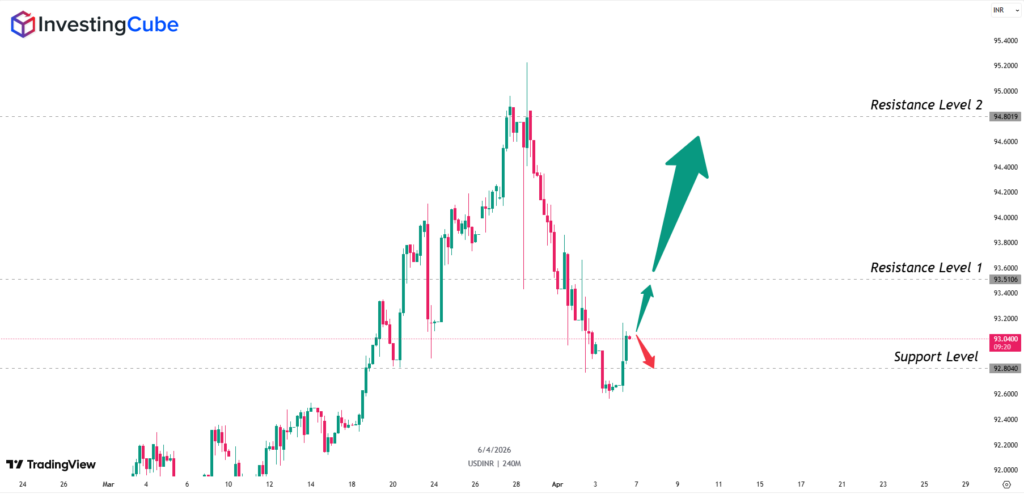
From a technical perspective, USD/INR seems to have entered the phase of short-term correction after an extended period of breakout. The pair immediately dropped after topping above 95.00 at the end of last month to a low of 92.79 intraday on April 6 before settling around steady just above lows and about 93.06. This will form an important support zone in the region of 92.80 to 93.00. Price has shown some falter here, but as long as price stays above this region, then it is difficult to assert the bearish outlook in its entirety and suggest the larger macro view terminated.
On the flipside, the initial resistance area resides at approximately 93.50 to 93.60. A breakout above that region would indicate the pair is attempting to regain momentum. More importantly, resistance above remains 94.80 to 95.20, the area associated with the recent panic spike and record rupee weakness. Should USD/INR rise again within that band, traders would probably view the recent pullback as merely a violent reset induced by RBI.

Momentum indicators similarly favor consolidation rather than a trend collapse. TradingView’s technical summary allegedly indicates a neutral daily signal, while it’s weekly and monthly readings project moderate bullish bias. Investing.com’s technical outlook, meanwhile, shows short-term selling pressure but an overall neutral background for moving averages. Those suggest near-term weakness exist, but that the larger bullish structure has not broken down decisively.
Why the Downside May Stay Limited
One key reason restricting further downside is investor appetite for dollars. The rupee rally, driven by the RBI, prompted more demand for hedging from importers, pushing one-year hedging cost sharply higher, a Reuters report said. That indicates real-money dollar demand remains active beneath the radar. Put differently, even if speculative demand dries up for now, any dips in USD/INR may still run into buying from companies looking to hedge dollar exposures.
That provides an important backstop for the pair. Under the hedging-induced hands off infrastructure that dominates these markets, places like that are hard for them to fall in a straight line — and each dip only makes corporate ad buyers more attractive. This leads to a dirty consolidation instead of a clean bearish reversal.
Price Outlook
This means that the immediate outlook for USD/INR remains mildly bearish to neutral, but not overly bearish. It is clear that the RBI intervention has altered the immediate tone and a pullback from above 95 to low-93 region is certainly meaningful. Still, also elevated oil prices, foreign outflows and geopolitical uncertainty held against looking for a lasting rupee recovery too soon.
The most probable near-term outcome is a corrective range of 92.80 and 93.60 as the market waits for RBI decision and keep close eye on crude oil. A persistent break under a 92.80 would indicate that the correction is deepening, potentially paving the way for a more prominent unwind of the late-March rally. However, if support holds and oil or geopolitical pressures escalate once more, USD/INR could build upside momentum again and also retest 94.80 (previous highs) to 95.20.
Frequently Asked Questions
The rupee strengthened because the RBI introduced new rules to reduce speculation in the FX market, which forced traders to close USD/INR positions.
Support is around 92.80 – 93.00, while resistance is around 93.50 – 93.60 and then 94.80 – 95.20.
Yes. If oil prices remain high and geopolitical risks stay elevated, USD/INR could regain strength and move back toward the 94.80 – 95.20.