


- We are currently at a rare "double-trigger" moment where the headlines from Pakistan and the data from Washington D.C. are equally capable of breaking the current technical ranges.
- Gold is currently "frozen" between the $4,700 support and $4,850 resistance, waiting to see if the weekend's diplomatic meetings can provide enough stability to offset the "hawkish" pressure from the U.S. inflation report.
Gold prices ticked lower in response to the cease-fire uncertainty rising after Israel’s ongoing strikes on Lebanon began. Spot gold slipped 0.2% to $4,742 per ounce at the time of writing. However, gold has gained nearly 2% so far this week. U.S. gold futures for June delivery, meanwhile, fell 0.9% to $4,776.60 today.
Gold is currently caught in a classic tug-of-war between two narratives. On one hand, the fragile ceasefire, with Israel still striking Lebanon and Iran warning of breaches, has prevented gold from crashing. On the other hand, when President Donald Trump announced a two-week ceasefire, gold immediately lost some of its “fear premium.” Investors are keeping a “safety net” of gold in their portfolio, protecting their investments just in case the Islamabad talks fail this weekend.
The Hidden Driver Behind Gold Price Beyond the War Narrative:
The hidden driver is not about war; it’s about the economy. The news of the ceasefire caused oil prices to decline. Lower oil prices mean lower inflation; therefore, gold started its bearish trend. Now that tensions have cooled slightly, the dollar is weakening. Since gold is priced in dollars, a weaker dollar makes gold cheaper for international buyers, which is currently supporting the price and preventing a deeper drop.
On top of that, today is a massive day for the markets because of the U.S. CPI release. The CPI is the mathematical driver that determines what the Federal Reserve will do with the interest rates. The consensus is that inflation jumped sharply in March to 3.3% (up from 2.4% in February). Here are the two scenarios for the Afternoon:
| Hot CPI (Above 3.3%) | Such data will cause a surge in the U.S. dollar and a gold drop. The market will bet on a rate hike or keep the rate unchanged for longer. This would put heavy pressure on the FTSE 100 and gold. |
| Cooler CPI (Below 3.3%) | Such data will cause gold to surge and the dollar to drop. The market will feel relieved, believing that the energy shock was only temporary. Such data could finally push gold past that $4,800 resistance. |
Gold Price Technical Outlook:
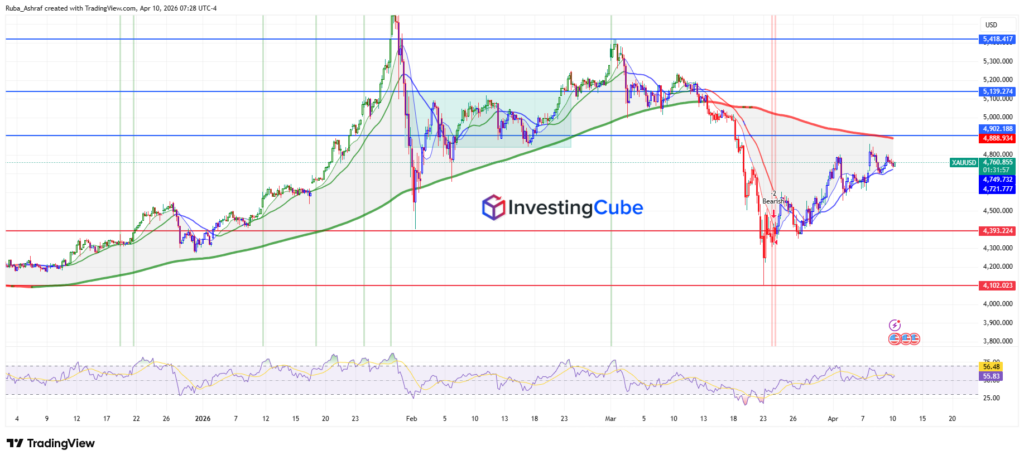
The technical outlook for gold (XAU/USD) shows that the market is returning to its macroeconomic roots. Trades are within a well-defined consolidation range. Gold entered a corrective phase, breaking below key support levels and falling under both short-term and long-term moving averages. The decline accelerated into a sharp sell-off, with the price dropping toward the 4,300–4,400 support zone. This support zone acted as a strong base, where buyers stepped in and prevented further downside. This leads to a noticeable rebound.

Currently, gold is recovering and trading around the 2,700-4,800 region. However, the structure has shifted from bullish to neutral-to-bearish in the short term. Price is now consolidating below the key resistance of 4,900. This aligns with the long-term moving average line that is now acting as dynamic resistance. This suggests that while the rebound is ongoing, the broader trend has not yet fully turned back to bullish.
The RSI has recovered from oversold levels and is now hovering in the mid-range. It indicates improvement, but still moderate momentum. Changing momentum will depend on today’s U.S. CPI release and the ongoing Islamabad peace talks. Overall, gold is in a recovery phase after a strong correction.
US CPI shapes expectations for interest rates. A higher-than-expected CPI could push rates up, making gold less attractive. A lower CPI may support gold by increasing the chances of rate cuts.
Gold often rises during geopolitical tensions because investors look for safe-haven assets. However, if tensions push oil prices higher and increase inflation, it can also strengthen the US dollar and interest rates, which may limit gold’s gains.