


- Silver price recently broke down strongly as high US interest rates and the Middle East war made the dollar stronger
- The metal's current recovery is supported by hopes of a ceasefire agreement between United States and Iran, which has raised industrial demand outlook
- Silver favours long-haul investors with higher risk appetite while gold is more attractive for investors seeking safety with comparatively lower earnings
Silver experienced an eight-session decline, marking one of its sharpest corrections since the notable surge to $122 per ounce in January. However, the metal has recently shown signs of recovery, climbing back toward the $70 to $80 range over the past two sessions. We discuss these developments and try to make sense of them.
Why Silver Price is Back Up
The rebound appears linked to a slight reduction in risk aversion following diplomatic movements and easing concerns about an immediate full blockade at the Strait of Hormuz. Silver’s earlier drop was influenced by investors tempering their expectations for rate cuts amid inflation worries tied to rising oil prices. The recent advance reflects a technical rebound coupled with renewed buying interest from retail investors.
Is the Recovery Sustainable?
Whether this recovery will hold remains uncertain in the short term. While silver’s industrial use tends to make it more sensitive to economic recovery than gold, ongoing inflationary pressures related to conflict and the likelihood of prolonged higher interest rates may limit its upside.
Analysts at JPMorgan and Bank of America project silver to average between $81 and $90 by 2026, but caution that price volatility could increase if demand from manufacturing weakens. This view challenges the assumption that silver will consistently outperform gold during conflict periods solely due to its industrial leverage.
A brief dip in Middle East conflict has cooled worries about oil-linked inflation, which previously boosted the US dollar. Because of this shift, silver begins to matter again, with demand from factories and significant safe haven value when markets wobble. Still, ceasefire talks hang by a thread, and should talks break down, prices might flip just as fast as they climbed.
Even so, both retail investors and institutions have adjusted their bets in a positive way. Though hit hard by recent swings, silver’s March 2026 futures contracts still hold gains above 25% since January, showing how deep the rally runs.

Silver vs. Gold: Which Is the Better Buy Right Now?
In comparing silver and gold as investments, gold is widely seen as being in the middle to late phase of its bull market. UBS forecasts gold could reach $6,200 in April, while Goldman Sachs forecasts $5,400 by December 2026. Gold’s appeal lies in its role as a stable, lower-volatility store of value amid geopolitical uncertainty. Silver, on the other hand, offers potentially higher returns driven by its structural supply constraints but carries greater volatility due to its industrial demand exposure.
For investors prioritizing risk management and capital preservation, gold is generally the preferred choice in the current geopolitical climate. Conversely, silver may be more attractive to those with a 12 to 18-month investment horizon who are prepared to tolerate significant price fluctuations in pursuit of higher potential gains linked to supply deficits.
Silver Price Forecast
Gold price the RSI has rebounded to 40, leaving plenty of room for upward movement. The immediate barrier is at the 10-day EMA at $74.86, followed by the 20-day EMA technical resistance at $78.27. The first key support is at $66.96. If this holds, the bulls maintain control of the medium-term structure. If it fails, it could open the way for the next support at $62.91.
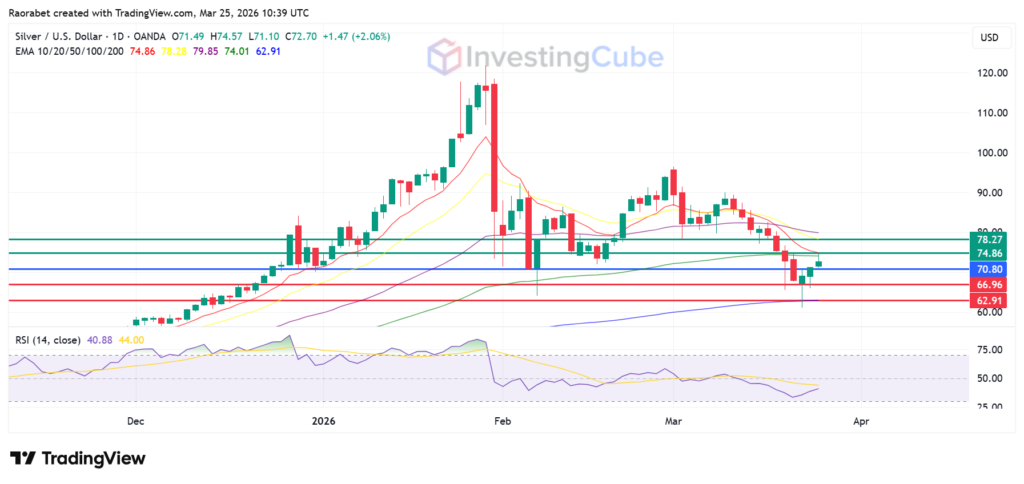
Silver price performance on the daily time frame with key support and resistance levels on March 25, 2026, as created on TradingView
The sell-off was triggered by a stronger U.S. Dollar and fears that the Fed would keep interest rates higher for longer. This led to long liquidation, which is when traders sold their positions to make up for losses elsewhere.
Sustainability is possible near-term on continued technical support, but inflation and manufacturing risks could cap gains. Investors should also be cautious about overestimating silver’s industrial leverage within a high-interest-rate environment.
As a pure monetary asset, gold protects you better from losses. On the other hand, silver’s use in industry makes it more volatile, which goes against the idea that it offers better leverage during times of uncertainty.