



- Interest rate divergence between the Reserve Bank of Australia (3.85%) and Bank of Canada (BoC) 2.25% have made the Australian dollar more attractive to carry traders
- Inflation remains sticky in Australia and above RBA's target, making a strong case for higher-for-longer interest rates in 2026
- Declining oil prices add pressure to CAD, while Australia's substantial reliance on commodity exports to China exposes AUD to China's economic pressures
The Australian dollar (AUD) has emerged as a standout performer this April, gaining roughly 1.5% against the Canadian dollar (CAD) over the last five trading sessions. As of this writing, the pair is trading close to 0.9745, which is a big jump from the 0.9602 it was at the beginning of the month.
Market consensus often attributes such moves primarily to oil price fluctuations. However, a closer look shows that the Reserve Bank of Australia’s more hawkish stance compared to the Bank of Canada’s more accommodating signals is causing a yield differential that is more stable than most traders realize.
What Is Driving the Uptrend?
The AUD’s gains reflect stronger domestic economic data and the RBA’s measured stance on interest rates. Central to this is Australia’s persistent inflation, which remains elevated despite broader global easing. The RBA recently raised its cash rate to 3.85%, pointing to inflation pressures that are still well above target levels. This move has reinforced expectations for a prolonged period of higher borrowing costs.
In contrast, the Bank of Canada faces pressure to pause or ease policy amid a soft growth outlook, with Deputy Governor Rogers voicing caution. Australian 10-year bond yields, projected around 4.1%, remain noticeably higher than Canada’s 3.7%, according to moneytransfer.com.au, attracting capital toward Australian assets.
Is the Momentum Sustainable?
If the current policy gap stays the same and commodity prices stay intact, sustainability in the near future seems possible. The RBA’s hawkish bias helps things along, but the Canadian dollar is still having trouble because the energy sector isn’t doing well.
Beyond oil prices, the interest-rate spread combined with Australia’s trade relationship with China may offer more sustainable support than currently anticipated. That said, sudden shifts in global risk appetite or unexpected easing from the RBA could quickly shift the dynamics.

Yet, while all eyes lock onto the RBA holding firm, few notice how tightly Canada ties itself to America’s surging growth. Should Washington keep expanding its fiscal spending, Ottawa may have no choice but to scramble after rate hikes faster than traders think. When that shift hits, the AUD/CAD edge gained just lately might vanish fast.
AUD/CAD Forecast
The pair is showing firm bullish momentum, with the RSI at 62. Short-term resistance is near 0.9775, with the second one likely at 0.9800, a psychological level that capped gains earlier this week. On the downside, support first appears at 0.9705, then the key structural floor around 0.9678.
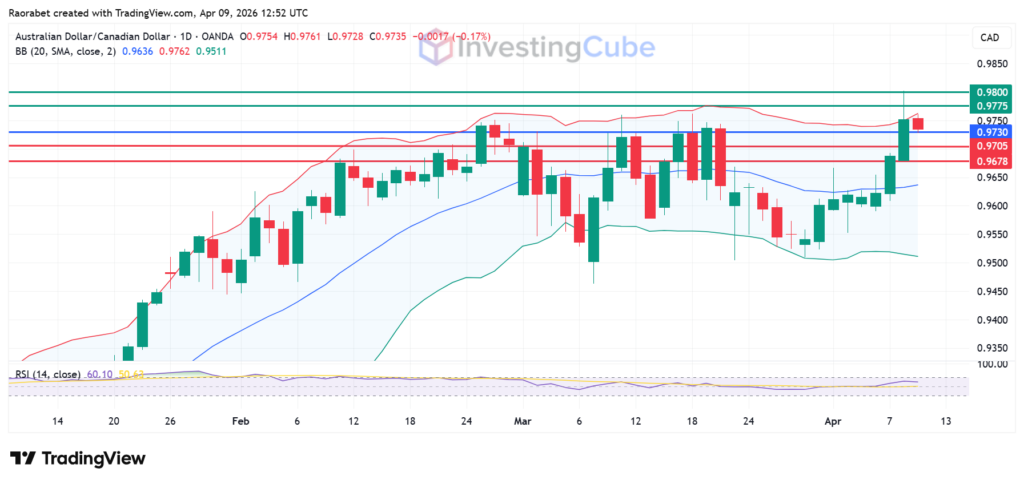
AUD/CAD FX pair on the daily chart with key levels of support and resistance on April 9, 2026. Created on TradingView
The main force behind the move is the policy divergence, with Australia’s 3.85% interest rate outpacing Canada’s 2.25%, making the AUD more appealing to yield-seeking investors.
Australia faces persistent inflationary pressures, particularly in services and construction sectors. The RBA’s February Statement on Monetary Policy indicated underlying inflation at 3.4%, surpassing its forecasts and justifying a tighter stance.
Sustainability is possible near-term if the policy gap persists and commodity prices hold steady. Consensus may overestimate oil’s influence, as yield differentials provide more durable support.