
- The Yes Bank share price is experiencing new demand following the recent stellar results and optimism around its upcoming bond issue.
Current Setup and Live Chart
The Yes Bank share price got off to a positive start this week, but has since lost buying momentum even as the stock respects a key support level. The support will be tested again over the week, and if it holds, it may lead some to believe dip buying is returning to the stock.
Yes Bank’s fundamentals suggest improvement after the bank reported a profit increase in Q1FY27. Net profit rose 33.7% year over year (YoY) to ₹1,071 crore, while the net interest income (NII) jumped 17.5% YoY to ₹2,786 crore. Earnings also improved, with Net Interest Margin (NIM) up 20 basis points YoY to 2.7%
Asset quality is also significantly healthier during the period under review, with gross and net non-performing assets at 1.3% and 0.2%, respectively. These prints indicate a very strong recovery from the FY2020 GNPA levels of 5.0%, during the bank’s restructuring period when it was under severe stress.
Presently, Yes Bank share price action is trading within a capital-allocation and earnings-compounding story. It has moved away from the balance-sheet repair narrative. The Yes Bank share price is currently trading at ₹22.74, with a 52-week range of ₹17.2 – ₹25.78.
Yes Bank Share Price: Current Macro Drivers
1) Accelerating Earnings
Yes Bank’s improvement in profitability is the highlight of its latest results. As mentioned earlier, profits rose 33.7% YoY on the back of a 17.5% YoY rise in NII. Operating profits also rose 25.5% YoY to ₹1,704 crore and NIM was up 20 bps YoY to 2.7%. The bank also reduced its cost profile, with cost-to-income declining from 67.1% the previous year to 62.8%.
These changes are significant, as they shift the narrative around Yes Bank from a turnaround story to a growth story. Such narrative shifts have significant implications for valuation, prompting a move from growth to returns on assets.
2) Shift of Investment Case to Loan/Deposit Growth, Other Fundamentals
The decline in non-performing assets points to improving asset quality. With asset quality now secured, investors and management can shift focus to other fundamentals such as loan growth, deposit mobilization, expansion of NII and fee income, and corporate/lending franchises. These are the factors that are drawing institutional interest in Yes Bank’s shares.
3) Capital is now a catalyst
Yes Bank’s board has approved raising additional capital of ₹16,000 crore via debt and equity. The management expects share dilution of no more than 10% for existing shareholders. The capital raise will catalyze loan growth and improve balance-sheet strength, but concerns remain that dilution will impact ROE. There is also the question of whether Yes Bank can utilize this additional capital to grow its franchise faster than the dilution impacts ROE.
4) International Bond Market Return
Yes Bank may be seeking a return to the international bond market by issuing 3-year dollar-denominated bonds, according to Reuters reports. This will mark the bank’s return to the offshore bond market since its older bonds were written off amid the 2020 crisis. This is a significant development, as a successful dollar-bond issuance will signal to the market that offshore investors are comfortable enough to resume lending to Yes Bank.
Yes Bank Share Price Catalysts
1) Capital and funding: the key catalyst here is the proposed fundraising by Yes Bank. A successful dollar bond issuance is a confidence-builder among the investing community. However, a dollar bond is essentially a loan taken from investors in foreign currency, the US Dollar. The cost of this bond (interest payments to investors) has to be evaluated against the bank’s earnings, which are predominantly in the local currency that has been largely hit by the oil shock risk premium.
2) NIM and deposit growth: the growth in NIM and the 20 bps rise YoY is a positive sign. However, the levels remain lower than those of many large private-sector banks. As the bank moves into the growth narrative, NIM and deposit growth are now crucial metrics used in measuring the bank’s growth. A healthy combination of deposit growth, cost of funds, NIM, and loan growth is desirable. A deterioration in this mix can negatively impact the bank’s NIM.
3) Macro environment, sector dynamics: the macro environment in India continues to be supportive, as expanding credit growth is expected to remain robust against the backdrop of strong economic activity. Yes Bank’s competitors in the private banking sector are benefiting from their scale, superior technology infrastructure, cost advantage, and expansive distribution network. Yes Bank would need to push itself to compete favorably without negatively impacting its cost structure.
Yes Bank Share Price: Forecast Scenarios for the Week Ahead
Base Case: The price is expected to trade in a consolidation with a moderate bullish bias, driven by the fundamental turnaround expected to gather pace in the coming months. However, the key test will be the bank’s ability to demonstrate sustainable earnings growth.
Bull case: Successful capital injection via the bond issue, strong deposit growth, improving NIM, and asset quality are factors that could force a move above 25.78 to jump-start a new uptrend.
Bear case: weakening deposit growth, poor loan growth, margin deterioration, and dilutive fundraising will undermine the Yes Bank share price. Furthermore, a sharp increase in the bank’s cost of funds will hurt earnings, bringing the turnaround story into question.
Yes Bank Share Price: Technical Outlook
A look at the 4-hr chart using the specialized indicator that detects support and resistance levels shows that the 22.25 support has held firm and has attracted new buying interest. The expected bounce toward the 24.06 resistance must clear the minor barrier at 23.20, the site of the prior high on 11 May. If this barrier is cleared, the march to 24.06 becomes the next objective. If this new target is surpassed, a move towards the 25.80 resistance cannot be ruled out.

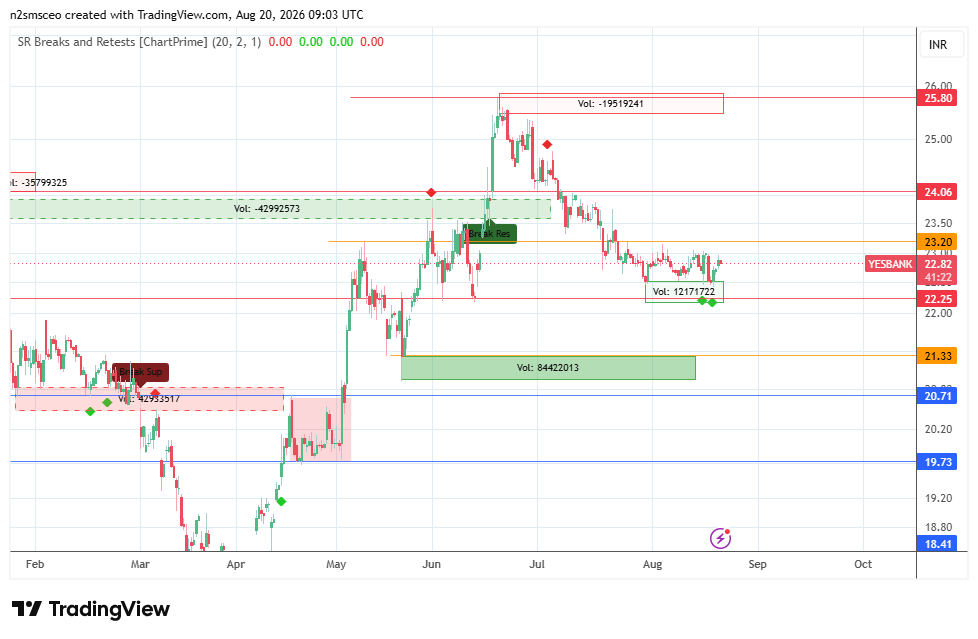
However, if 22.25 breaks under new bearish pressure, the 21 May low at 21.33 becomes the new downside objective. Below this level, 20.71 is the 13 February low and forms the additional downside pivot if the decline is more extensive.