
- BSE profit triples to ₹602Cr, marking its 11th straight quarter of record-breaking growth.
- Stock faces a "painful reset" as new RBI rules on broker funding hit trading volumes.
- Traders eye the ₹2,740 floor, can BSE hold support despite the 10% regulatory sell-off?
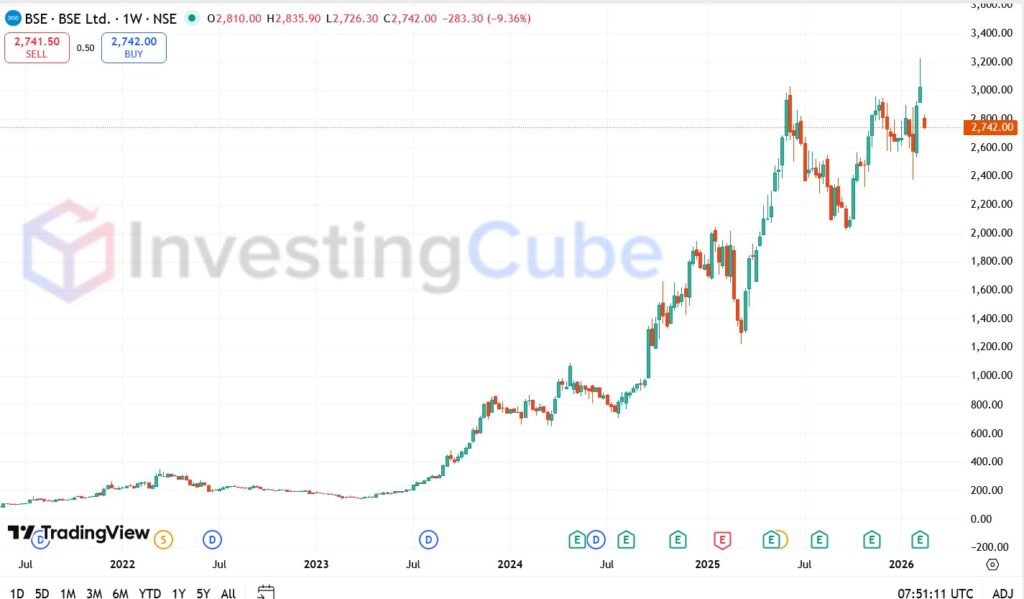
BSE Limited (BSE) shares are navigating a volatile Tuesday session, as the exchange operator grapples with the fallout from new regulatory hurdles. After a massive 10% plunge on Monday, the stock opened today at ₹2,809.90 before slipping as low as ₹2,740.10 in intraday trading. This “painful reset” follows a surprise move by the Reserve Bank of India (RBI) to tighten the screws on market liquidity.
The RBI “Shockwave”: Why BSE and Capital Market Stocks are Crashing
As reported by Reuters, Indian capital market intermediaries are facing a sudden liquidity squeeze after the RBI over the weekend mandated 100% collateral for bank lending to stockbrokers.
Leverage Squeeze: Brokers must now lock up significantly more of their own capital, with bank guarantees to exchanges requiring 50% collateral backing, of which 25% must be pure cash.
Proprietary Trading Ban: Under the amended RBI Directions 2026, banks are now prohibited from funding proprietary trading, a massive blow considering “prop” desks drive roughly 40% of futures and options (F&O) turnover.
Earnings Impact: According to analysts at Jefferies, the new regulations could result in a 10% hit to BSE’s earnings, as the exchange operator is highly exposed to the high-frequency trading segments impacted by these rules.
BSE Q3 Financials: A Record-Breaking Foundation Meets Regulatory Headwinds
Despite the current stock market jitters, BSE is coming off its strongest fundamental performance in history.
- Consecutive Records: BSE recently reported its 11th consecutive record performance, with total revenue for the December quarter hitting an all-time high of ₹1,334 crore, up 61% year-on-year.
- Profit Surge: Consolidated profit nearly tripled to ₹602 crore, fueled by a surge in equity derivatives, mutual fund transactions, and new listings.
- Operational Efficiency: While revenue soared, operating expenses actually declined by 4%, landing at ₹512 crore.
BSE Share Price Forecast
Technically, the stock is in a short-term “Downtrend” as it tests critical moving averages.
- The Resistance ($2,812 – ₹3,025): For bulls to regain control, BSE needs to reclaim the ₹2,812 intraday high and eventually break back above the ₹3,000 psychological barrier.
- The Support ($2,740 – ₹2,553): The immediate “line in the sand” is today’s low of ₹2,740. If this fails, the next major structural support sits at the 200-day DMA of ₹2,553.
- Market Sentiment: Currently, analyst ratings remain largely positive, with nearly 69% of analysts maintaining a “Buy” rating despite the regulatory volatility.

BSE Price Outlook: Final Takeaway for Traders
BSE enters mid-February 2026 as a tale of two realities: a record-shattering growth engine versus a sudden “liquidity reset”. While the 61% revenue growth and tripling of profits highlight the exchange’s dominance in the F&O and mutual fund segments, the RBI’s new collateral norms have introduced a tactical cooling period.
The crackdown on proprietary trading is a “cleansing” of the market that may hurt short-term volumes but stabilizes the long-term tech-driven ecosystem. For investors, the ₹2,727 support is the level to watch; if the stock stabilizes here, the record-breaking fundamentals are likely to outweigh the regulatory noise as we move toward the next fiscal year.
Check out the India AI Impact Summit 2026 here.
BSE FAQs
The drop was triggered by the RBI’s new credit facility norms, which restricted bank funding for proprietary trading and raised collateral requirements for brokers.
As of mid-day Tuesday, February 17, BSE is trading near ₹2,751, down roughly 1.7% from its previous close.
The primary risk is a potential drop in derivative trading volumes as higher funding costs and transaction taxes dampen speculative activity in the F&O segment.