

- The Sensex index is making a gradual recovery to pre-war levels, but the index still has to deal with external headwinds.
Current Setup and Live Chart
The Sensex Index is heading into the new week on the back of an increasingly headline-sensitive backdrop. Indian stocks appear to be benefiting from the general improvement in risk appetite following the de-escalation of the geopolitical situation in the Middle East, along with gains on Wall Street and other global exchanges. The Sensex is trading higher this Monday, but the advance has been moderated as investors continue to reassess risks from the geopolitical space and commodity markets.
The Sensex Index continues to battle external influences, mostly from the ongoing US-Iran geopolitical situation, which has led to an increase in oil prices. India is the third-largest crude oil importer in the world, and elevated crude oil prices put pressure on the rupee and increase expectations for imported inflation. It also puts pressure on corporate margins of stocks listed on the Sensex. As a result, the Sensex index’s valuation remains a battle between the improvements in domestic fundamentals of its listed stocks and external risk factors.
Sensex Index: Macro Drivers
1) Domestic Earnings
Resilience in domestic demand and improved corporate earnings are supporting the Indian stock markets. The Sensex index has benefited from this, as it makes its slow recovery back to pre-war levels. Investors are watching for data on consumer spending and industrial activity. They are also focusing on domestic support factors, such as banking sector profitability and expanded infrastructure investments by the Indian government.
2) Oil Prices
India is the third-largest importer of crude oil in the world. This dependence on imported crude makes oil prices one of the important macro drivers for the Sensex. Sustained increases in Brent crude prices will pressurize the rupee, increase the country’s import bills, and raise expectations of imported inflation. It also reduces the purchasing power of the populace, leading to cuts in discretionary spending. Furthermore, higher oil prices raise input costs for Sensex-listed corporates. On the flip side, a reduction in oil prices improves the country’s trade balance and also lowers the margin compression that corporates face from increased energy costs.
3) Foreign Institutional Flows
Indian stock indices feature a large percentage of foreign portfolio funds. This makes the Sensex index highly vulnerable to foreign institutional flows. Conditions that promote foreign institutional outflows put pressure on the Sensex index.
4) Global Risk Sentiment
Recent U.S. data have pushed back expectations of a Fed rate hike, which has boosted U.S. and Asian equities. Indian stocks have taken a cue from the performance of their U.S. and Asian counterparts and have begun the week on a firm footing. This is a supportive backdrop for the Sensex and is a pointer to the improving risk sentiment governing Indian stock markets.
Sensex Index: Price Catalysts
1) US-Iran developments: this continues to be the most important price catalyst for the Sensex index. The market will continue to monitor the news wires for any significant military developments, as well as headlines on the ongoing diplomatic negotiations. Furthermore, any changes in shipping conditions across the Strait of Hormuz or in the geopolitical risk premiums are likely to sway the direction of Indian indices. Most importantly, within the context of the recent escalation, any change to the opposite side (renewed escalations) would exert negative pressure on the Sensex index.
2) Rupee and foreign flows: The rupee plays a central role as far as the interaction between foreign portfolio flows and the Indian stock markets is concerned. Foreign portfolio funds have to be converted from foreign currencies to the rupee to participate in the Indian stock markets. A weaker rupee is typically accompanied by heavy foreign portfolio selling, which is a negative signal for the Sensex. On the flip side, a more stable rupee encourages foreign portfolio investment buying, which strengthens the Sensex’s bullish case.
3) Corporate earnings: Corporate earnings and Indian domestic data are major price catalysts for the Sensex. Particular attention will be paid to the banks and financial services industry, the industrials, as well as IT and consumer companies. Traders will be looking to see if their current corporate earnings results justify the current valuation of the Sensex.
Sensex Index: Weekly Forecast Scenarios
Base case: domestic growth and a positive earnings backdrop are expected to support the Sensex, but headwinds from elevated energy prices mean that this support will translate into a muted upside push. Therefore, the base case scenario is one of cautious bullishness.
Bull case: if crude prices drop below $75 and there is significant de-escalation, along with a stable rupee and better-than-expected corporate earnings, the bull case scenario will manifest. This will see the Sensex recovering close to its pre-war price levels of February 2026.
Bear case: if the US-Iran war suffers another round of escalation along with a sharp rise in energy prices, this leads to more Rupee weakness and foreign portfolio fund outflows. Under these conditions, we could see the Sensex lose the grounds it had gained since June 2026.
Sensex Index: Technical Outlook
The Sensex index is making a slow but steady recovery towards the 79825 resistance and former degraded support formed by the lows of 8 August/29 August 2025 and 1 February 2026. A break of this key barrier is required for the index to aim for the 84,000 psychological resistance, which houses the 27 June 2025 and 19 February 2026 highs. Above this level, the 2026 high at 86264 becomes the next upside target.

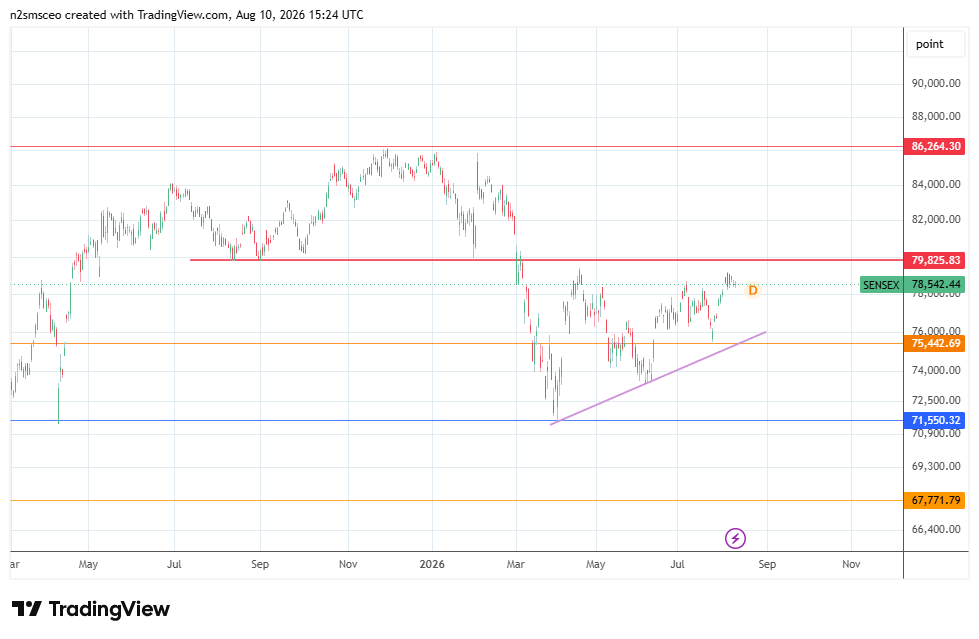
On the other hand, the 75442 support and low of 24 July becomes the next downside target if there is a rejection from 79825 and a pullback. The 7 April 2025 and 2 April 2026 lows at 71550 come into the picture if the bulls fail to defend the 75442 support.