
Current Setup and Live Chart
The Dow has surged to a new record high after rising 0.6% in early Friday trading to 26,300. The advance is tied directly to recently released corporate earnings, as well as a de-escalatory development in the Middle East. Germany’s industrial production and exports have beaten market expectations, providing a bullish signal for the German economy.
The gains on the DAX that have sent the index to record highs have been driven by the technology sector, especially chip makers and software companies. Companies like Infineon Technologies, SAP, Brenntag, Scout24, and Rheinmetall have all advanced, giving the index a good push to the north ahead of key U.S. employment data that’s expected to impact global stock markets.
The expectation is that Germany’s large defense infrastructure expansion will support the index’s medium-term growth. Investors are currently balancing the strong corporate earnings and recent German fiscal stimulus against any potential headwinds from inflation, higher energy prices, or renewed geopolitical uncertainty.
Macro Drivers for the DAX
1) German Fiscal Expansion
A major driver for the DAX is Germany’s increased spending on infrastructural development and defense, with the latter coming on the back of the Russia-Ukraine war. This increased government spending has had a profound positive effect on several companies listed on the DAX, especially defense and industrial stocks. Engineering firms, banks, infrastructure suppliers and construction companies have also benefitted from the spending boost. This positive structural catalyst also has the potential to create tailwinds for several DAX stocks in the long run, which boosts the chances of the DAX hitting new record highs above the 27K mark.
2) Boost in Corporate Earnings
A boost in corporate earnings has also contributed positively to the DAX’s recent performance profile. Earnings from Deutsche Bank, SAP and Rheinmetall have been extremely important in ensuring that any risk-off sentiment from the geopolitical risk premium and oil shock has largely been offset. The major constituents of the DAX’s weighting have performed well in terms of earnings, which has helped investors to look beyond the oil shock risk premium and relatively muted domestic growth.
3) Oil Prices
Global stock markets are usually averse to higher oil prices, especially if they are weighted towards companies that incur higher costs from the rise in energy prices. Germany’s heavy manufacturing and industrial activity render the country susceptible to higher oil prices. The DAX’s leaning towards the industrial complex makes it vulnerable to increases in production costs, producer inflation, and compression of company margins that occur with a rise in oil prices. Within the context of the geopolitical risk premium, the recent announcement of a cessation of military strikes by US President Trump is seen as de-escalatory. It has led to a fall in oil prices, providing a supportive tailwind for German equities into record territory.
Price Catalysts for the DAX Index
1) Middle East geopolitics: the DAX will benefit from de-escalation of the tensions, and will face headwinds if the military conflict resumes. The current de-escalatory environment supports the DAX’s push into record territory.
2) German and Eurozone economic data: data around factory orders, industrial production, manufacturing PMIs, inflation, and growth expectations are movers of the DAX index. The bullish narrative around the DAX will be reinforced if the data point to signs of stabilization.
3) Corporate earnings: corporate earnings are a seasonal influence on the DAX’s valuation. Earnings delivery has largely been positive, which is supporting the bullish narrative. The markets will be looking to see if these can be sustained in subsequent quarters.
DAX Index: Forecast Scenarios
Base case: cautious bullishness due to a combination of fiscal expansion and strong corporate earnings. However, the DAX has advanced to a point where profit-taking is nearly inevitable. The index is now vulnerable to consolidation.
Bull case: the bullish case scenario is supported by strong corporate earnings, improvement in German growth data, and de-escalation of Middle East geopolitical tensions, which produce a fall in oil prices. This will lead the DAX into a risk-on scenario with outperformance in industrial stocks. R
Bear case: further escalation in the Middle East geopolitical situation, weak German data, or disappointing earnings. This could fuel inflationary expectations and a hawkish ECB. Investors will also reduce their exposure to cyclicals and industrial stocks, rotating into defensive stocks. Under these conditions, we could see a pullback from the current record levels.
DAX Index: Technical Outlook
The DAX is on its way towards the 26944 price mark, which is the 27% Fibonacci extension of the 23 March to 6 July upswing. This followed the break of the previous all-time high at 25900. If the price manages to surpass this level, the 61.8% Fibonacci extension at 28336 becomes the new price target for the bulls.

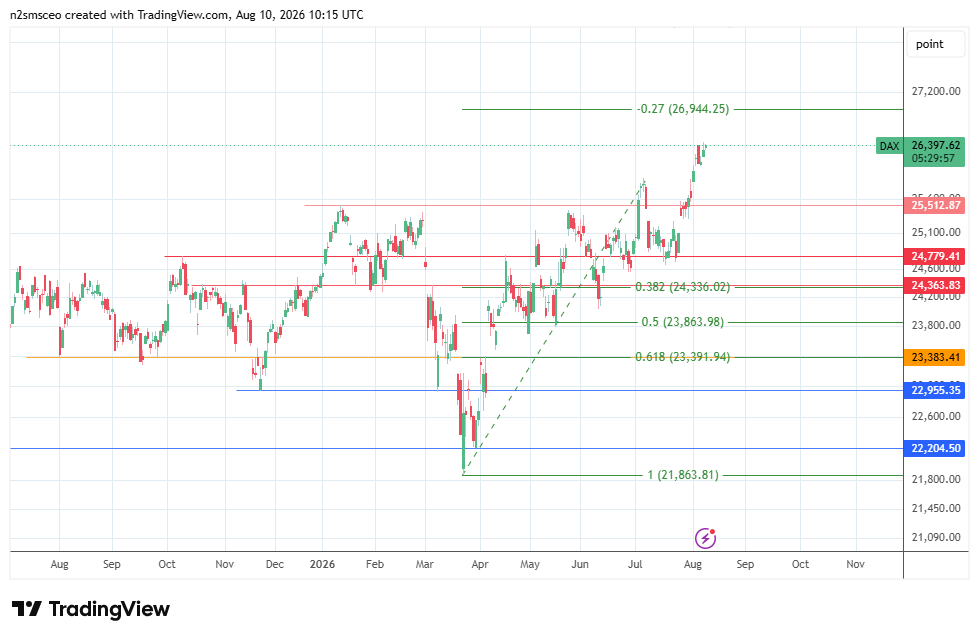
On the flip side, a retracement below 25900 and the 25512 support and high of 13 January makes a case for a further retreat towards the 24779 support. Below this level, 24363 becomes the new downside target.