
- The USD/JPY is experiencing heightened volatility following Thursday's intervention and the BoJ's hawkish hold on Friday.
Current Setup and Live Chart
The USD/JPY fell 2.38% on Thursday after a suspected intervention by the Bank of Japan and Japanese financial authorities. This move came as the Japanese Yen exchanged at 164 yen to the U.S. dollar, following several months of weakness against the greenback.
On Thursday, the Japanese Yen had its biggest intraday rally in several years after a suspected intervention from Japanese financial authorities. It was later revealed that the intervention was coordinated with U.S. authorities, leading to a 2.38% drop in the USD/JPY. The intervention came as the Yen hit its highest levels in history, clocking in at 164.00 before the intervention took place.
Earlier this morning, the Bank of Japan delivered its policy decision and left its policy rate unchanged at 1.00%-1.25%, which met expectations. However, it emerged that a single policy board member had dissented and voted for an immediate rate increase to 1.25%. Furthermore, Bank of Japan Governor Kazuo Ueda also warned that underlying inflationary risks remain tilted to the upside and signaled that the bank might take further steps to tighten if economic conditions evolve as projected. These two events reinforced the view that the Japanese central bank is becoming uncomfortable with Yen weakness and is now possibly moving to tighten monetary policy at its next meeting. Following the BOJ’s decision, the Yen weakened slightly but remains largely lower, as it stays below the pre-intervention levels.
USD/JPY Macro Drivers
1) BoJ Intervention Changes Sentiment
The market volatility that followed the suspected interventionist action by the Bank of Japan indicates that the Japanese financial authorities appear finally prepared to defend their currency after the US JPY hit price levels that are now viewed as economically damaging to the Japanese economy. The intervention indicates that authorities are now uncomfortable with what is viewed as excessive yen weakness, and this is now challenging speculative put-sharding on the pair. With the price still trading around 1.60, traders continue to face risks from potential intervention. Volatility in the US JPY has decreased as a result of the actions of the last few days and continues to pose a threat to any aggressive long-dollar position.
2) BoJ Turns More Hawkish
After years of accommodative monetary policy, the Bank of Japan’s language appears to have shifted toward a more hawkish tone, which markets interpret as more constructive for the Japanese Yen. Specifically, Governor Ueda emphasized that there are still elevated underlying risks to the Japanese economy in terms of inflation and that wage growth continues to support domestic inflationary levels. He has also hinted that additional rate hikes are a possibility and that the bank would continue to evaluate any upside inflation risks. More importantly, a policymaker voted for an immediate rate hike to 1.25%, suggesting the BOJ is gradually shifting from accommodative to more restrictive policy. The markets are now increasingly pricing another rate hike before the end of 2026.
3) USD Still Supported After Fed’s Hawkish Hold
Despite events out of Japan in the last two days, the USD remains relatively supported, following the Fed’s hawkish hold at Wednesday’s Federal Reserve meeting. Fundamentally speaking, the pair remains dictated by the interest rate differential, which continues to favor the U.S. dollar over the Japanese Yen. The Fed has maintained a hike-for-longer policy and reiterated this on Wednesday. This has kept U.S. Treasury yields elevated, and U.S. interest rates remain sitting kindly higher than Japanese interest rates.
4) Geopolitical Uncertainty
Being a net energy importer, Japan remains vulnerable to the geopolitical crisis in the Middle East. The recent escalation has sent oil prices soaring from $70 to levels between $85-$100. The ongoing US-Iran conflict is still a source of USD safe-haven demand, which comes at the expense of the Yen that typically faces headwinds from surging energy prices.
USD/JPY Price Catalysts (Near-term)
1) Confirmation of intervention
Markets will keep looking for official confirmation of the interventionist moves from Japan’s Ministry of Finance. Also, any commentary from key finance officials in Japan or the US Treasury that points to a potential repeat of the intervention could exert more volatility on the pair.
2) US Treasury yields
US Treasury Yields are still largely higher following the Fed’s hawkish hold on Wed. This sustains the yield differential between the greenback and the Yen, which remains a dominant price catalyst that has supported USD longs for several months now. Rising US bond yields continue to support the pair, with USD/JPY trading closer to 160.00. Carry trades will remain attractive as long as the rate differential between the Fed and BoJ is maintained, which could bring the Yen back under renewed pressure.
3) BOJ communication
Further communication from Bank of Japan Governor Ueda or other Japanese policymakers could provide a hint as to the timing and scale of any rate hikes, wage growth, and inflation projections. Any narrative that hints at an approaching rate hike would likely be Yen-supportive.
USD/JPY Forecast Scenarios
Base case: the intervention and hawkish tone of the BoJ is expected to lead to a mildly bearish bias on the USD/JPY, as these have largely spooked speculative longs on the pair.
Bull case: if US data on inflation and employment for July end up being stronger-than-expected, a return to USD/JPY bullishness is expected. This could allow the pair to retest recent all-time highs. However, this bullish move may be shortlived if the Japanese financial authorities intervene once more.
Bear case: falling US Treasury yields, stronger Japanese inflation data, data regarding wage inflation or further communication from the BoJ that reinforces the hawkish rhetoric could allow the pair to retrace further. This outlook is further cemented by disappointing US data.
USD/JPY Technical Outlook
The upside move following the BoJ rate decision has met a brick wall at the 160.53 resistance, site of the prior highs of 30 March and 30 April 2026. A decline from this level makes a case for a retreat towards the 157.64 support, where the prior highs of 21 November and 19 December 2025 now act as role-reversed pivots. The 1 May 2026 low at 155.51 is the next downside target if 157.64 is degraded.

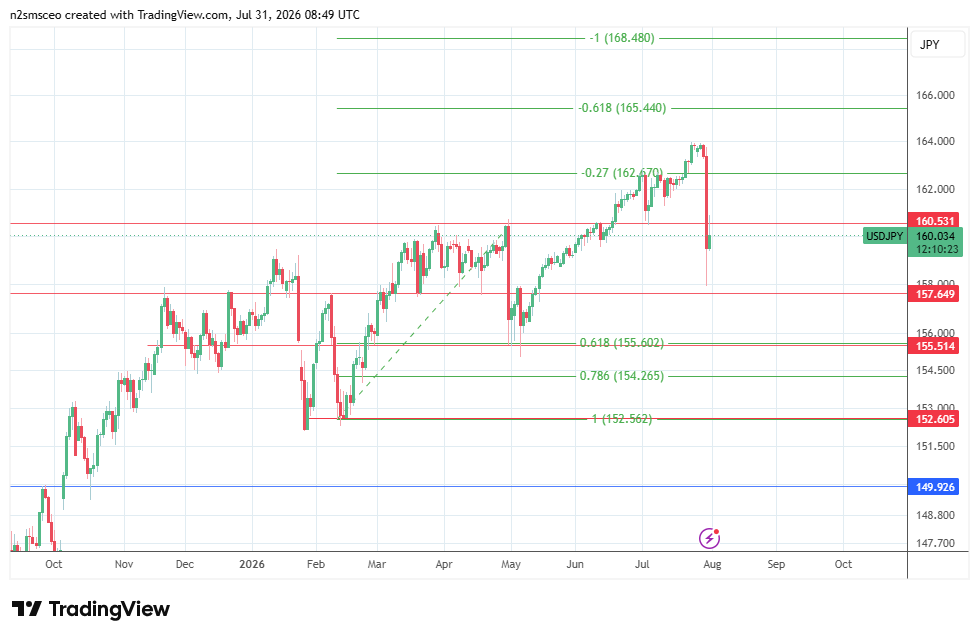
On the flip side, a break of 160.53 allows for a retest of the 27% Fibonacci extension at 162.67. If this barrier is uncapped, the all-time high of 164.00 comes into the picture. Barring any intervention, 165.44 is the 61.8% Fibonacci extension that serves as the next upside target if 164.00 is breached.