

- USD/INR hits an all-time intraday high of 92.528.
- Brent crude soared to $120/bbl due to Middle East escalations and closure of a critical supply choke point.
- The Nifty 50 dropped below 24,000 as "risk-off" sentiment triggered heavy foreign outflows.
A Historic Plunge
On March 9, 2026, saw the Indian rupee (INR) climate to a new all-time Low against the US dollar (USD), on an intraday basis sinking down to 92.528. This steep drop is lead primarily by an unprecedented jump in global crude oil prices after the escalation of the Middle East conflict and the effective closure of the Strait of Hormuz. The central bank (reserve bank of India or RBI) has been active in preventing volatility, but the twin pressures from capital flight and deteriorating trade fundamentals are proving to be a big drag on the Indian currency.
Latest Market News: The”Oil Shock” of 2026
The biggest catalyst for the market moving today is a huge surge higher in energy cost. Brent crude futures soared more than 25% to go above $118 a barrel, heating peaks around $120 briefly. That is the highest price point since Ukraine was invaded in 2022.
The Strait of Hormuz Blockade
War escalation among the U.S., Israel and Iran resulted in the shutting down of a critical choke point — the Strait of Hormuz, which usually handles 20% of global daily oil supplies or 15 to 20 million barrels. With India importing about 80 to 85% of its needs when it comes to crude oil, and a significant amount passing through this route, the blockade has become an existential threat to energy security and trade balance for the country.
Domestic Equity Collapse
The “risk-off” sentiment lad to a sharp sell off in Indian equities. The Nifty 50 and Sensex crashed nearly 3% during early trade on Monday, with the former going below the crucial 24,000 mark. Foreign Institutional Investors (FIIs) have turned to strong selling mode, pulling more than $350 million in the day from the Indian stocks and flocking to US dollar and gold.
Macroeconomic Impact on India
The spike in oil prices has clear and adverse impact on India’s twin deficits:
- Current Account Deficit (CAD): According to analyst, every 10% increase include oil prices translate into an approximate CAD expansion of 0.4% of GDP for India. The trade gap, of course, is set to widen rapidly now with oil prices up nearly 50% over the past week.
- Inflationary Pressure: When state buffers are ignored, domestic petrol and diesel prices have today remained largely unchanged, experts say sustained high crude oil costs will reflect in higher transport as well as food inflation.
- Monetary Policy: U.S labor market weakness with 92,000 jobs lost in February fueled some speculation for a Fed rate cuts in the back half of the year, but the immediacy of energy-led inflation could keep central banks hawkish.
Central Bank Response: RBI Intervention
The Reserve Bank of India (RBI) has switched to active defense mode. Traders say the central bank has been selling dollars with state-run banks in both the spot and forward markets to prevent a “free-fall” of the rupee. The RBI current approach centers around controlling “abnormal or excessive volatility”, and not defending a certain level of exchange rate. Notwithstanding such, the strength of imported dollar demand and FII outflows has ensured that it is difficult to reverse the downward trend.
Technical Outlook and Trend Inference

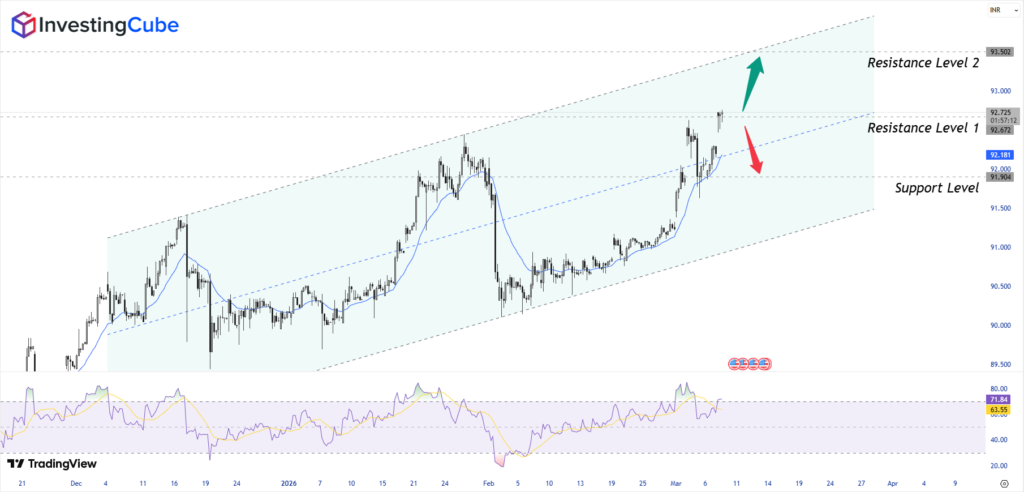
Key Technical Levels
- Key Resistance: 92.68 (Recent ATH; major psychological level”
- Target Resistance: 93.00 (Immediate target if oil stays above $100)
- Immediate Support: 91.90 – 92.00 (Ideal zone to book some short-term profit)
- Trend Support: 91.43 (20-day Exponential Moving Average)
Trend Analysis
USD/INR is clearly on a bullish bias over the short-term. The pair has formed a series of higher highs and higher lows with a firm break above the key 92.00 level. The 14 day relative strength index (RSI) recently hovered close to 74, a reading consistent with overbought conditions, although this could imply a temporary technical retreat, the fundamental pressure from the Middle East conflict, typically trumps technical oscillators during crises.
Potential Trajectory
- Bearish Scenario for Rupee (Most Likely): If the pipeline blockade of the Strait of Hormuz is prolonged and Brent remains firm above $115, it is very likely that within next trading sessions, USD/INR may test once more 93.00 level.
- Consolidation scenario: If the RBI steps in full swing and global diplomatic efforts of signal a potential de-escalation, it may consolidate between 91.90 – 92.40.
- Long-Term Outlook: Despite the grim near-term outlook, some analyst believe a medium term structural recovery remains possible in the 86.00 to 87.00 range by late 2026 if recent India-US trade framework benefits, make export more competitive and geopolitical risk abates.
Conclusion
The move in USD/INR today is a classic “black swan” energy supply shock. The market will remain extremely sensitive to any news on Iranian oil facilities and US troop movements in the region. That said, investors should keep an eye on the resistance around 92.67, if that level is broken, we could have a fast move to 93.50.
Frequently Asked Questions
Due to large “oil shock”. Brent cru prices sword 25% or more to nearly $120 a barrel as the Middle East conflict ratcheted up. The Strait of Hormuz was closed. Since India imports most of its oil, this geopolitical crisis with the currency hard.
Rising oil prices took a toll on India’s “twin deficits”. Based on empirical estimates, CAD typically increases by around 0.4% of GDP for every 10% rise in crude prices. Moreover, fuel prices and significantly enhance inflationary pressure on transport and food because of high energy cost, despite domestic fuel prices is being temporarily buffered by the government.