

- The EUR/USD forecast is for a potential upside continuation as US Pres Trump says a Hormuz deal could be reached on Wednesday.
The EUR/USD is inching higher this Wednesday as the US Dollar retreats following a shift in sentiment, with hopes for positive negotiations between the US and Iran on the geopolitical front gaining momentum. This Wednesday, the greenback is broadly lower as the markets digest the impact of falling US bond yields and softer US labor market indicators. Falling oil prices have also removed the safe-haven appeal of the US Dollar, with investors now willing to assume more market risk.
Furthermore, the US Dollar is also taking a beating after the ADP Non-Farm Employment Change surprised to the downside. US private sector employment as measured by this data set came in at 44K, lower than the market expectation of 68K and the prior of 95K.
The EUR/USD is currently trading 0.1% higher as of writing.
EUR/USD Macro Drivers
1) Retreating Treasury Yields
Today’s biggest macro driver is the decline in US bond yields due to softer US labor market data and reduced dollar appeal from falling oil prices and geopolitical de-escalation. Additional factors include profit-taking from recent dollar longs and rotation away from defensive dollar positioning toward a risk assumption.
2) Easing Geopolitical Fears
The recent pause in new US strikes has provided some relief to the markets on the geopolitical front. Despite the unresolved conflict, any headlines that point to a pause in hostilities are a piece of much-needed good news for a market that is looking drained by the elongated nature of the war. Oil prices are trading below $80 a barrel, suggesting a reduction in the geopolitical risk premium and improved market sentiment.
3) Markets Now Reassessing the Fed Outlook
Last week’s Federal Reserve meeting was interpreted as a hawkish hold. However, the reduction in fuel prices, the lowering of US bond yields, and the underwhelming US labor data released so far are forcing markets to reassess the Fed’s outlook. If the NFP data points to a slowing of US public sector employment and further inflation data suggests moderation, the Fed expectations could start turning dovish.
4) Stable Eurozone Fundamentals
Despite the growth concerns and the impact of rising energy costs on the energy-import-dependent single area, the single currency is benefiting from the ECB’s cautious stance. Furthermore, recent inflation data (Eurozone Core CPI Flash Estimates YoY: actual 2.5%, consensus/prior: 2.4) indicate that inflation has not disappeared totally. These factors are helping to create stability for ECB expectations and are currently supportive of Euro strength.
EUR/USD Near-Term Price Catalysts
1) US Data: Upcoming data from the US that will be on the watchlist of traders include Friday’s Non-Farm Payroll report. Subsequently, the consumer spending and consumer/producer price index data will also hit the newswires. If the data points to lowered US economic resilience, the weakness in the US Dollar could continue.
2) US Treasury Yields: Declining US bond yields will lead to a reduced demand for USD-denominated assets, which invariably supports further gains on the EUR/USD. On the flip side, USD strength is restored if bond yields start rising once more.
3) Middle East geopolitics: Headlines around the state of shipping or military encounters in the Strait of Hormuz will impact oil prices. If there is a renewal of bombardments, the markets will interpret this as a sign of escalation, and this would revive the USD’s safe-haven appeal at the Euro’s detriment.
EUR/USD Forecast Scenarios
Base case: moderate bullishness is expected, with the recent pullback in the USD expected to extend if US bond yields remain pressured. Furthermore, the cooling of geopolitical tensions and stable ECB policy expectations are expected to provide further support for the pair.
Bull case: a combination of weak US data, continued de-escalation on the geopolitical front, and additional declines in US bond yields could see more USD longs being liquidated. Under these conditions, the EUR/USD may reclaim the 1.1670 resistance level or higher.
Bear case: if US bond yields resume the upside trend, coupled with better-than-expected US data and renewed fighting between the US and Iran, this is supportive of a bear case scenario. This scenario sees a further widening in the interest yield differential between the Euro and US Dollar, and a retreat in Fed rate cut expectations. A retreat towards support levels below 1.14 is the price expectation here.
EUR/USD: Technical Outlook
The break of the neckline at 1.1480 confirms the bottoming pattern (progressing rising lows at 1.1324 and 1.1363). This unlocks the door for a measured move that is expected to complete at 1.1577, the prior low of 19 January 2026 and the lower edge of the resistance zone, with 1.1581 as the upper edge. Only when this zone is breached can the 1.1671 resistance (30 April 2026 low and neckline of the 16 April and 12 May 2026 double top) become available as a new upside target.

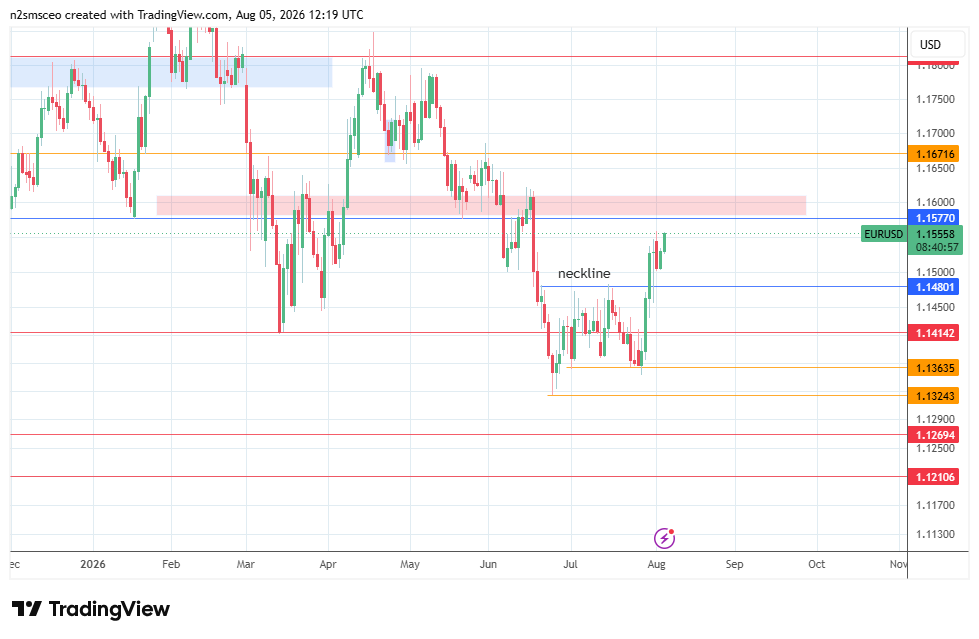
On the flip side, this upside move is only invalidated if the bottoming price levels are degraded, which leaves room for continuation of the recent near-term downtrend towards 1.1269, the high of 17 July 2023. A further downside target at 1.1210 (23 September 2024 high) becomes the next downside target if 1.1269 is breached.