

- The CHF/JPY is currently in consolidation, with traders seeking for fresh triggers ahead of the BoJ's policy decision on 31 July.
Current Setup and Live Chart
The CHFJPY remains one of the FX market’s safe-haven currency pairs. Both currencies function as safe-haven assets that attract demand during times of geopolitical escalation. However, differing interest rate expectations between the Swiss National Bank and the Bank of Japan drive demand for both currencies, and this is a key driver of price action in the pair.
Within the current environment of global risk aversion, the Swiss Franc has attracted stronger flows due to the country’s low inflation, a strong external balance, and the SNB’s policy flexibility. On the other hand, the Bank of Japan’s policy normalization strategy is still largely seen as accommodative. Furthermore, Japan is a net energy importer and the current environment of high energy prices continues to put pressure on the Yen due to the high energy import bills. Recent price action shows that the currency pair is trading within a consolidation, with the 198.76 and 204.37 price levels serving as the price floor and ceiling, respectively. As we head toward the end of July, this leaves traders searching for new triggers to determine the pair’s price direction.
CHF/JPY Macro Drivers
1) Safe-haven demand
Both currencies receive safe-haven demand during times of heightened geopolitical uncertainty. Specifically, there is demand for government bonds in Switzerland and Japan, the Yen, and CHF-denominated assets. However, there is some degree of relativity when it comes to the shifts in defensive capital flows. The shift in capital flows determines the pair’s direction.
2) Divergent Monetary Policy
Interest rates are low in both countries, but the policy trajectories differ. The SNB is expected to maintain flexibility as long as inflation remains contained. On the flip side, the BoJ’s policy expectation is gradual normalization, with the potential to tilt toward an acceleration in the tightening process.
3) Geopolitical Uncertainty
The Yen faces additional pressure from geopolitical uncertainty due to its status as a net-energy importer. Uncertainty keeps safe-haven flows elevated and raises the volatility levels across both currencies, with the pair trading within wider ranges than is normally the case.
Price Catalysts for the CHF/JPY
1) Geopolitical developments: The markets will keep watching for new developments and headlines around the military situation as well as the Strait of Hormuz, which is currently blockaded.
2) Central bank communication: Such communication from the Swiss National Bank and Bank of Japan typically centers around interventions. For the SNB, the direction of intervention is to weaken a stronger Franc, while the BoJ usually intervenes to strengthen a weaker Yen within the current geopolitical dispensation. Changes in policy guidance would also change expectations due to the relative differential in the interest-rate status in both countries.
3) Global risk sentiment: The markets are currently in risk-averse mode. Demand for the currencies rises during risk-off periods, while risk-on market environments reduce demand for the CHF and the JPY.
CHF/JPY Forecast Scenarios
Base case: the current consolidation mirrors the base case scenario, which is why the pair is currently consolidating. Both currencies are beneficiaries of the geopolitical situation, which means that neither has a competitive advantage over the other based on this metric.
Bull case: if there is stronger demand for Swiss assets, or the BoJ remains slow in normalizing its rate policy, we could see more defensive flows to the Franc and a corresponding rise in CHF/JPY. This will enable the pair to break the upper boundary of the consolidation and pursue new highs.
Bear case: more aggressive policy normalization by the BoJ along with a decline in Swiss yield expectations will trigger the bear case scenario. Furthermore, Yen appreciation from stronger demand during market stress heightening will lead to a stronger Yen relative to the Franc. This will lead to a retracement move in the CHF/JPY, breaking the downside barrier of the range.
CHF/JPY Technical Outlook
The pair is currently in consolidation. A break of the upper boundary targets the 211.57 price mark, which serves as the 100.0% Fibonacci extension of the 26 May – 28 October 2025 price swing. A further push to the north brings in the 141.4% Fibonacci extension at 219.51, which is also the end-point of the measured move of the rectangle pattern from its pole commencement point at the 186.11 support (25 July 2025 high).

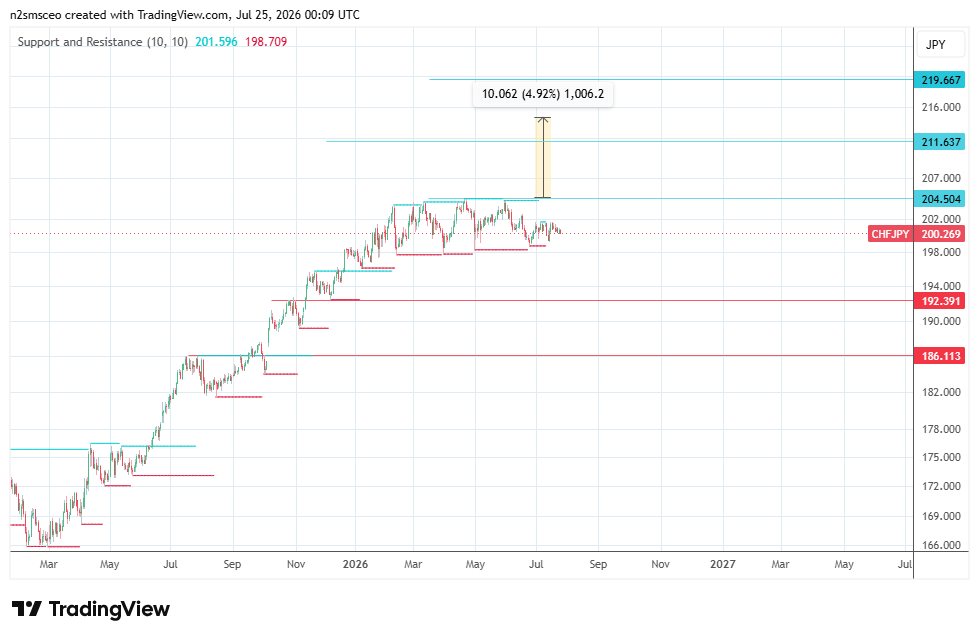
On the flip side, a breakdown of the 197.57 support and 27% Fibonacci extension unlocks access to the 192.39 low of 4 December 2025, followed by a touch down at 186.11 if the bulls degrade this support. This move would invalidate the bullish continuation towards 211.57 and 219.51.