

- The AUD/USD is seeing a cap on its medium-term uptrend move as geopolitical tensions escalate further along the Strait of Hormuz.
Current Setup and Live Chart
Regarding AUD/USD performance this week, the balance of risks is tilted toward modest weakness, with volatility likely to stay elevated due to market responses to Middle East geopolitical activity and US monetary policy expectations.
Currently, the AUD/USD is trading within a regime of risk sentiment vs safe-haven demand. The AUD currently benefits from resilient commodity exports, backed by the potential for more accommodative Chinese policy support. However, a strong US Dollar and elevated US Treasury yields have overpowered the AUD’s support channels and have put the pair under pressure.
The geopolitical climate is currently in an escalatory phase, which continues to drive safe-haven demand for the greenback at the expense of risk-associated commodity currencies such as the Aussie Dollar. On the other hand, investor sentiment and any positive stimulus developments from China will be the factors the AUD will look to for support. However, the market’s bias is currently for capital preservation via the flight to safety, even as oil prices continue to rise.
AUD/USD Macro Drivers
1) Bullish USD Sentiment
Despite last week’s U.S. inflation data showing a cooling of inflationary pressures in June, the U.S. dollar continues to retain broad-based strength, driving bond yields higher and generating safe-haven demand. The greenback is gaining support from continued expectations of caution on the part of the Federal Reserve in easing rates. Additional support also comes from stronger demand for U.S. government bonds as well as safe-haven flows. The market perception is that the U.S. economy remains resilient and robust, and these factors are expected to cap further rallies in AUD/USD in the near term.
2) China’s Economic Outlook
Australia’s robust export base, as well as the relative stability in commodity prices for gold, copper, natural gas, and iron ore, have helped to boost the country’s terms of trade and have formed a slight cushion against the strengthening of the U.S. dollar. Although this supportive metric has been overwhelmed by safe-haven demand for the greenback, it still offers partial support for the Aussie dollar, limiting the downside potential of the pair.
3) Commodity Prices
Australia’s robust export base, as well as the relative stability in commodity prices for gold, copper, natural gas, and iron ore, have helped to boost the country’s terms of trade and have formed a slight cushion against the strengthening of the U.S. dollar. Although this supportive metric has been overwhelmed by safe-haven demand for the greenback, it still offers partial support for the Aussie dollar, limiting the downside potential of the pair.
Price Catalysts for the AUD/USD
1) US economic data and Federal Reserve expectations
This is a key price catalyst for the AUD/USD. Data around US inflation and employment change (NFP) are critical in shaping the Fed rate expectations. Strong US data leads to a rise in US Treasury yields, which promotes a “higher for longer” Fed policy expectation.
2) Chinese and Australian economic releases: Australian employment change came in at 76.3K, which beat the consensus of 16.4K. The prior number was also revised upwards to 44.0K. The unemployment rate stayed at 4.4%. The robust outlook for the Australian labor market following this data provides for a near-term counter to the US Dollar’s strength, but the medium-term outlook stays in favor of the greenback. Of greater importance to the AUD’s outlook is the Chinese data set that comprises the
Chinese PMIs, industrial production, retail sales, and PBoC policy announcements. These Chinese data are considered critical to Australia’s export outlook.
3) Global risk sentiment: The AUD/USD is highly sensitive to risk sentiment. The Aussie Dollar is favored in risk-on market scenarios, while the US Dollar benefits from safe-haven demand. The current geopolitical tensions around the US-Iran conflict are a risk-averse situation: they promote a flight to safety into the USD. They are negative for both China and the Australian economy. De-escalation promotes risk-seeking sentiment, which is supportive of the Australian dollar.
AUD/USD Forecast Scenarios
Base case: neutral to mildly bearish due to the current balance between upbeat Australian employment data to counteract the current US Dollar strength, which is coming from higher US Treasury yields.
Bull case: softer US data and a decline in Treasury yields from the US end, boosted by stronger-than-expected Chinese stimulus measures and an improved environment for risk appetite, will cause commodity currencies such as the AUD to outperform while leading to weakness on the US Dollar.
Bear case: geopolitical escalation that leads to more flight to safety, stronger-than-expected US economic data, and a further rise in Treasury yields will boost the greenback. If there is no support from Chinese economic data, the AUD will be offered, creating a situation where the pair will slide below current support levels.
AUD/USD Technical Outlook
Price remains in a medium-term uptrend. However, the latest round of USD strength has kept the pair range-bound, with the 0.7130 resistance and prior highs of 15 August 2022 and 30 January 2023 acting as the upper boundary. The 19 June 2023/16 September 2024 price highs at 0.6886 form the lower boundary.

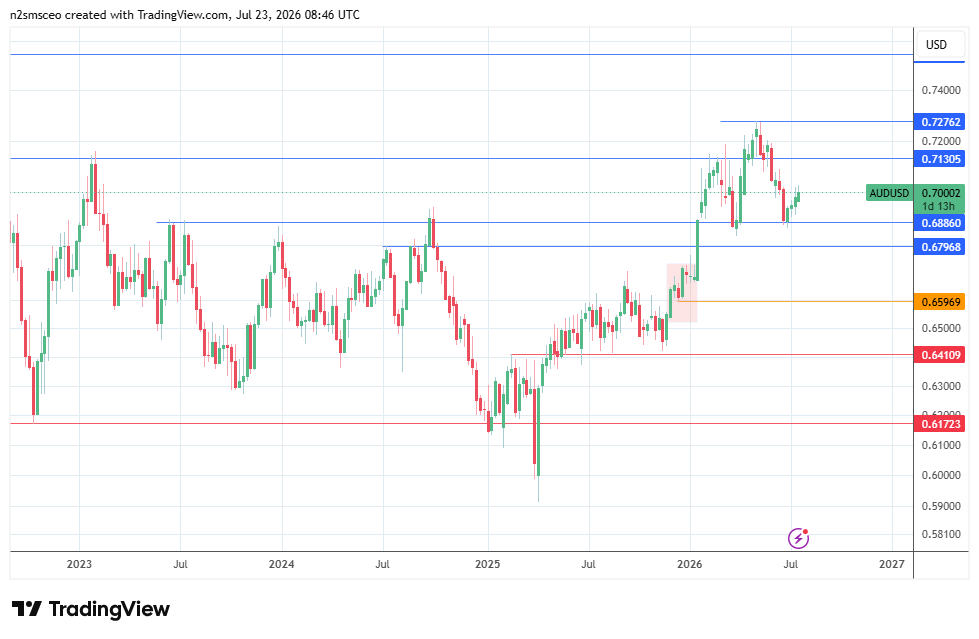
The bulls need to uncap the upper boundary at 0.7130 to clear a path to the May 2026 high at 0.7276. Beyond this barrier, the next resistance comes in at the November 2021/March 2022 high at 0.7547.
On the flip side, a breakdown of the 0.6886 support unlocks access to downside targets at 0.6796, followed by 0.6596 if the retracement is more extensive. Below this price mark, which is formed by the low of 15 December 2025, a further pivot that holds the lows of May-November 2025 is showcased at 0.6410.