

Current Setup and Live Chart
The trading week is now in its second day, and the GBP/INR pair is currently trading 0.4% lower on the day. The pair lost its early gains as sentiment around the rupee has been boosted by the first update since the Reserve Bank of India introduced a range of measures to attract foreign inflows into the country. The Reserve Bank of India said $20.72 billion had been mobilized through to 17 July, with foreign currency non-resident deposits accounting for about $17.5 billion of the total.
This has created a condition for a retracement in GBP/INR despite improving UK economic sentiment. Overall, the Indian rupee remains pressured by elevated oil prices, which arose from the new geopolitical tensions in the East.
Oil prices have now hit $90 per barrel. The country’s status as the third-largest crude oil importer keeps the currency vulnerable despite the RBI’s interventions.
GBP/INR Macro Drivers
1) Improving UK Fundamentals
Improved UK fundamentals have supported the pound as recent developments have strengthened investors’ confidence in the UK currency. These factors include:
- better-than-expected good data
- stabilization of UK government bonds
- improved fiscal credibility
- resilient labor market conditions
The UK Claimant Count Change came in at 6.7K, which was far less than the market expectation of 29.4K. Furthermore, the average earnings index came in at 4.3%, which is a tad lower than the trial and consensus numbers. Public sector borrowing fell from £20 billion to £16.0 billion, which was lower than the consensus number of £17.8 billion. The unemployment rate stayed at 4.9%. The market has had a positive response to the numbers, reinforcing renewed investor confidence in the pound and the UK economy.
2) Higher Oil Prices
India is the world’s third-largest oil importer. As a result, higher oil prices increase the country’s energy import bill, add current account pressures on the Indian economy, and increase the risk of imported inflation. Furthermore, there is an increased demand for foreign currency to pay for energy imports. Higher oil prices also lead to risk-averse sentiment, which promotes capital outflows from the Indian stock and bond markets. This generally creates a situation where existing funds have to be reconverted into foreign currency, further increasing FX demand.
3) Diverging Macroeconomic Risks
The market perception is that the UK’s economy is on a path of better fiscal and monetary policy management, while India is facing several challenges arising from higher energy prices, such as inflation and increased current account pressures. The divergence in fiscal and monetary policy expectations between the two countries has become increasingly supportive for the pound at the expense of the rupee in the near term. This perception supports a GBP/INR upside trajectory in the medium term.
GBP/INR Price Catalysts
1) Bank of England Rate Expectations: Incoming UK data on growth and inflation will provide a directional market bias for the Bank of England’s monetary policy direction. Hawkish BoE expectations are expected to follow strong data, which is supportive for the Pound. Weak data will turn expectations dovish, allowing for a retracement in GBP/INR.
2) Brent crude prices: Oil prices are a key price catalyst for the rupee. Higher oil prices weaken the rupee, which is supportive for the pair even in the absence of strong UK data. On the flip side, lower oil prices strengthen the rupee, allowing for a relief retracement on the GBP/INR.
3) Geopolitical developments: geopolitical developments in the Middle East are an ongoing price catalyst. De-escalation of tensions is rupee-supportive as this has a calming impact on oil prices. De-escalation signals come from continued shipping across the Strait of Hormuz, diplomatic negotiations, and a scaling down of military developments.
GBP/INR Forecast Scenarios
Base case: Recent UK developments—including firmer growth- have strengthened the Pound, while higher oil prices have put the rupee on the back foot. Unless there are changes to the prevailing fundamentals, the balance of risks is currently tilted toward the Pound, which supports an upside bias.
Bull case: oil prices > $100 per barrel will further weaken the rupee as energy import costs rise. Investment demand will also shift away from emerging market FX such as the rupee, even as the accompanying risk aversion drives capital out of the Indian markets. Under these conditions, the GBP/INR could break above recent resistance levels.
Bear case: this is triggered by a sharp decline in oil prices, dovish Bank of England expectations, or a rapid de-escalation of Middle East tensions. Under these conditions, the rupee’s outlook will become more favorable, resulting in a retracement on the GBP/INR.
GBP/INR Technical Outlook
The retreat towards the 128.90 support makes a case for a dip buy at that point. If that support is breached, the retracement extends toward the 127.38 support. The 124.32 support and site of the recent swing low beckons if the 127.38 support buckles under bearish pressure.

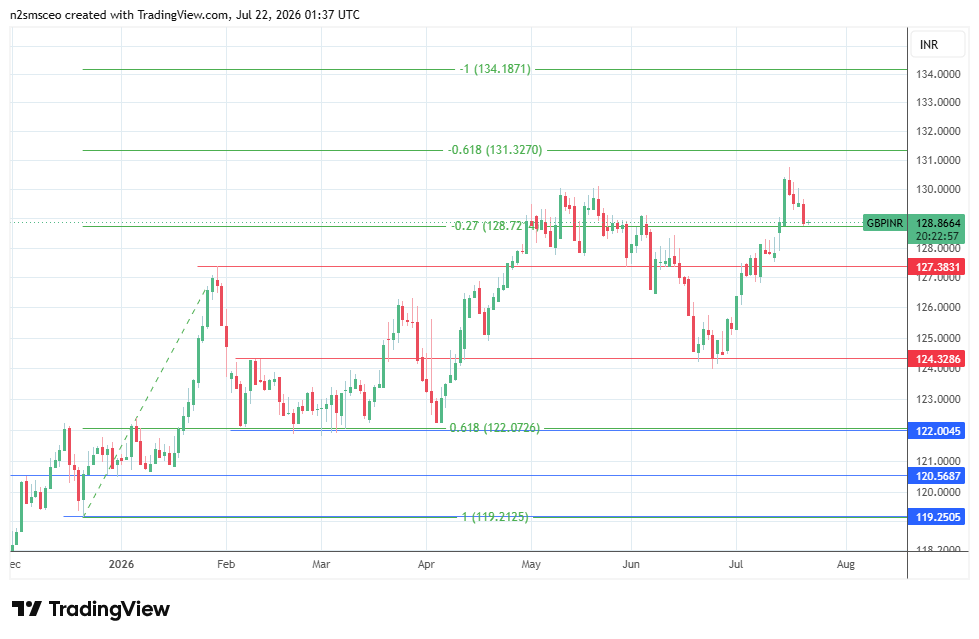
However, a bounce on 128.90 allows for a push towards the 13132 resistance and 61.8% Fibonacci extension. This is consequent upon an uncapping of the 130.00 psychological resistance. Above this, 134.18 serves as the next barrier, being formed by the 100% Fibonacci extension level of the 22 December 2025 – 21 January 2026 upswing.