
- Oil prices are back on the upward trajectory as new US-Iran fear resurface amid vessel strikes in Strait of Hormuz on Monday.
Oil Prices: Current Setup
Brent crude oil prices are trading higher, up 2.95% as of writing. This comes as further uncertainty around the U.S.-Iran conflict resurfaces.
Oil prices had eased dramatically on Monday after U.S. President Donald Trump indicated that he had canceled plans to strike Iran to give room for diplomatic contacts. However, the markets are still pricing in a meaningful geopolitical risk premium into oil prices as military assets remain deployed in the Persian Gulf. Furthermore, tensions continue around the Strait of Hormuz as a vessel was reported missing after a missile strike in Hormuz on Monday.
Oil prices are also benefiting from U.S. economic resilience. The boost in consumer confidence and consumer spending keeps oil demand higher via increase utilization of refined products. On the supply side, investors are also watching whether OPEC+ will step in to signal a willingness to increase output to stabilize the market, and whether they will maintain current production discipline. Therefore, oil prices remain in a state of fine balance between geopolitical surprises and macroeconomic headwinds.
Macro Drivers for Oil Prices
1) Ongoing Geopolitical Risk Premium
The U.S.-Iran conflict continues to be a source of ongoing geopolitical risk premium for oil prices. Even though fears of a full-scale regional escalation have somewhat moderated, the situation remains highly fluid. Investors will continue to monitor the state of military activity in the Persian Gulf, as well as the security of commercial shipping across the Strait of Hormuz. Furthermore, markets will also be looking at U.S. military deployments. Even without any form of physical disruption to supply, there is always a possibility of escalation, which is a source of upside risk to prices.
2) OPEC+ Supply Discipline
The OPEC+ alliance has so far maintained production discipline, and this is supportive of oil prices. The market would continue to focus on whether the cartel has spare production capacity to boost production to stabilize prices and whether it will maintain export discipline. Furthermore, any revisions to existing production quotas, as well as voluntary price cuts, could help offset some of the supply disruption if needed.
3) Stronger U.S. Dollar
Despite shedding some of its July gains, the U.S. dollar still maintains relative strength compared with its peers. This follows the Fed’s latest meeting, which led to a rise in U.S. bond yields due to the Fed’s hawkish stance. A stronger dollar makes crude oil more expensive for non-U.S. buyers. It also weighs on demand from emerging markets and limits upside during risk-off periods. This has been a factor that has offset strong bullishness even in the face of the new geopolitical
4) Resilient Global Demand
August signals the summer travel demand season. Despite slowing growth in several developed countries, oil demand continues to be driven by summer travel. Increased aviation fuel usage by airlines, increased emerging market consumption, a boost in petrochemical activity, and resilient U.S. economic growth are global demand drivers for oil prices. Furthermore, Chinese industrial activity is expected to pick up, providing a further boost to the demand factor.
Oil Price Catalysts (Near-term)
1) Geopolitics: This is the most important near-term price catalyst. Changes in oil prices from military actions/deployments, headlines from negotiations, the state of shipping across the Strait of Hormuz, and any attacks on energy infrastructure in neighboring countries (a sign of broader regional conflict) are all factors within the geopolitical risk premium.
2) OPEC+ communication: the monthly OPEC oil report, commentary from OPEC+ ministers with respect to production quotas, compliance with existing quotas (supply discipline), or willingness to tap into spare capacity to stabilize the market are factors captured under this heading.
3) State of US inventories/external demand: the US had indicated its inventories were at multi-decade lows, which makes the EIA weekly crude oil inventories report of great importance at this time. Further data on US gasoline demand during the holiday season, refinery utilization, and Chinese industrial data are important factors in gauging demand.
Oil Prices: Technical Outlook
The uptick in prices is now testing the 86.34 resistance (14-17 July highs). A break of this barrier unlocks access to the 90.79 resistance (31 July high), closing the week-opening gap. A further push beyond 90.79 brings the 102.00 resistance into the picture, being the prior high of 23 July.

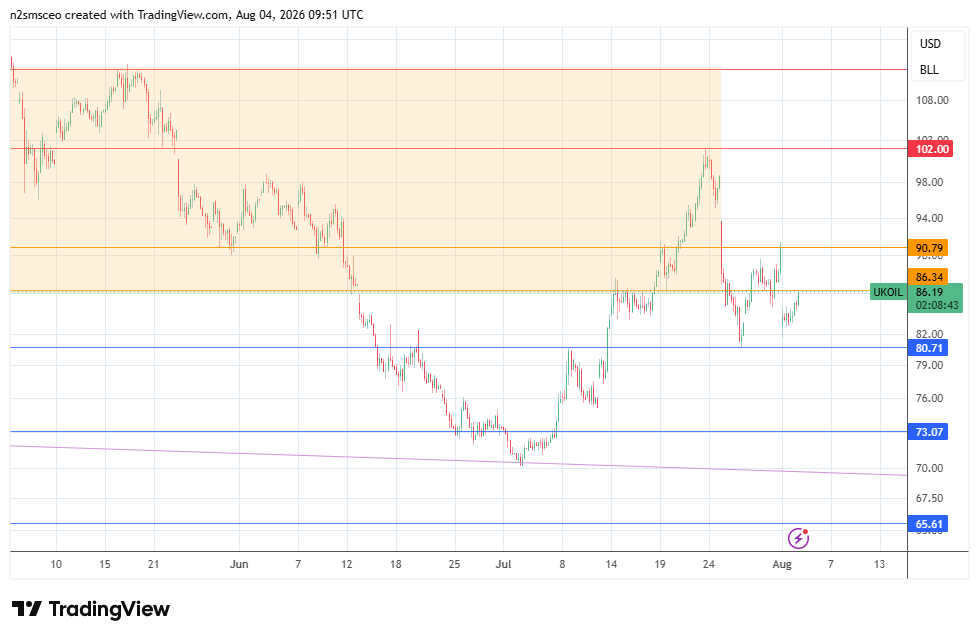
On the flip side, rejection at the current barrier makes a case for a retrace and retest of the 80.27 support. If this pivot gives way, a move to the 27 February high of 73.07 cannot be ruled out.